
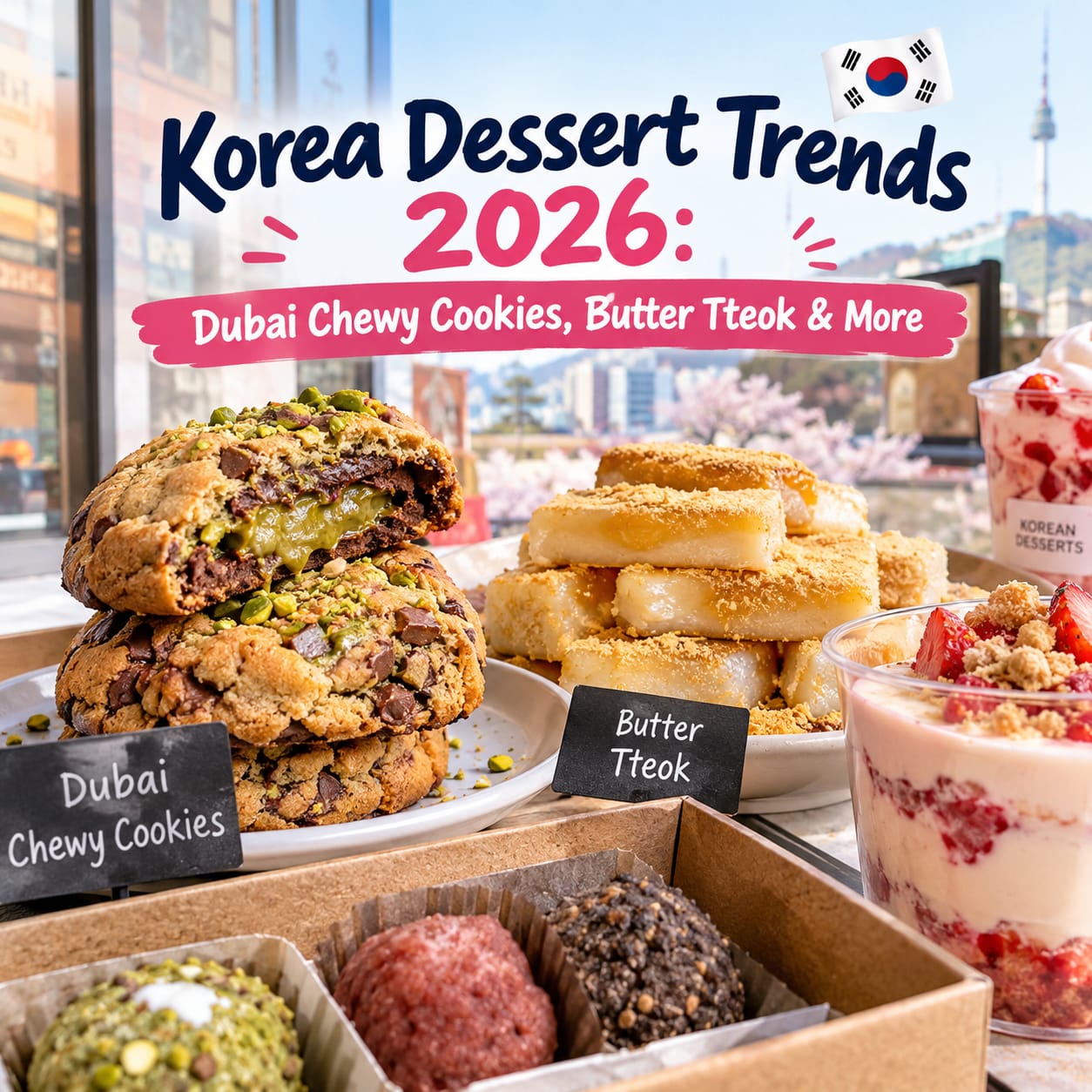
Korea Dessert Trends 2026: Dubai Chewy Cookies, Butter Tteok & More
Discover Korea’s biggest dessert trends in 2026, from Dubai Chewy Cookies and butter tteok to traditional Korean sweets. Find out what to try in Seoul, where to look, and how foreign visitors can navigate Korea’s cafe scene.
South Korea’s dessert scene moves fast.
A dessert can become a social-media sensation, inspire dozens of variations, appear in convenience stores and then be replaced by another trend within months. That makes Korea one of the most exciting places in Asia for travelers who enjoy cafes, bakeries and food trends.
In 2026, one of the biggest examples has been the Dubai Chewy Cookie, widely known in Korea as dujjonku (두쫀쿠). The dessert combines a chewy marshmallow exterior with pistachio filling and crispy kadayif, creating the contrasting textures that helped make it a social-media phenomenon. Korea Tourism Organization identified the Dubai Chewy Cookie as one of Korea’s major dessert trends in 2026.
Another major trend earlier in the year was butter tteok, a modern rice-cake dessert inspired by the texture of traditional Korean tteok. Korean cafes, bakeries and food companies quickly embraced the idea, while social media helped spread it nationwide.
But there is a bigger story here.
Korea’s 2026 dessert culture isn’t just about one viral cookie. It is about texture, creativity, Korean ingredients, global influences and the rapid reinvention of traditional sweets.
If you’re visiting Seoul in 2026, here’s what you should know.
🇰🇷 Korea Dessert Trends 2026 at a Glance
| Trend | What to expect | Best for |
|---|---|---|
| Dubai Chewy Cookie | Marshmallow, pistachio and crispy kadayif | Viral-food fans |
| Butter Tteok | Buttery, chewy rice-cake texture | Tteok lovers |
| Modern Tteok | Traditional rice cakes with new flavors and fillings | Cultural food experiences |
| Yakgwa | Traditional Korean honey cookie | Traditional dessert fans |
| Chapssaltteok | Soft, chewy rice cake with sweet filling | First-time visitors |
| Dubai-style Korean desserts | Korean snacks reimagined with pistachio and kadayif | Trend hunters |
| Convenience-store desserts | Affordable versions of viral trends | Budget travelers |
1. Dubai Chewy Cookie: Korea’s Viral Dessert Phenomenon
If you’ve spent any time watching Korean food videos online, you’ve probably seen the Dubai Chewy Cookie.
The Korean version is different from the original Dubai chocolate that inspired it.
A typical Dubai Chewy Cookie combines:
- chewy marshmallow
- pistachio cream or spread
- crispy kadayif
- chocolate or other sweet components, depending on the shop
The result is a dessert built around texture contrast.
The outside is soft and stretchy. The pistachio filling provides richness, while toasted kadayif contributes a delicate crunch.
That combination made the dessert particularly attractive on social media.
Korea Tourism Organization describes the Dubai Chewy Cookie as a major K-dessert trend and notes that the idea has expanded into other Korean foods, including bungeoppang, yakgwa and convenience-store products.
What does “dujjonku” mean?
Dujjonku (두쫀쿠) is the Korean nickname associated with the Dubai Chewy Cookie.
If you see 두쫀쿠 on a Korean menu, social-media post or cafe sign, you’re likely looking at a Korean-style Dubai chewy dessert.
The exact recipe isn’t standardized, so two cafes can produce noticeably different versions.
That’s part of the fun.
2. Why Dubai Chewy Cookies Became So Popular
The dessert arrived at the perfect intersection of several Korean food trends:
Global food inspiration + dramatic texture + social media + limited availability.
Photos and videos of the cookies being pulled apart made them extremely shareable.
Some popular shops experienced long queues and sold out quickly, while larger food companies began introducing their own Dubai-inspired products.
Yonhap reported in February 2026 that the trend had spread nationwide, with bakeries experiencing queues and major companies such as Starbucks Korea and Paris Baguette introducing their own Dubai-inspired products.
The trend also developed its own Korean variations.
Korea Tourism Organization lists examples including:
- Dubai Chewy Cookie
- Dubai Bungeoppang
- Dubai Chewy Yakgwa
- Dubai Chewy Gimbap
- Dubai-style rice cakes
- convenience-store Dubai desserts
This is an important part of Korean food culture.
A global trend arrives in Korea, and Korean businesses quickly reinterpret it through familiar local foods.
3. Butter Tteok: Another Major 2026 Dessert Trend
If the Dubai Chewy Cookie represents Korea’s fascination with global flavors, butter tteok represents the country’s ability to turn a texture into a trend.
Butter tteok became a major social-media dessert trend in Korea during early 2026.
The concept is associated with huangyou niangao, a Shanghai-style butter rice cake. The Korean version typically combines glutinous rice-based ingredients with butter and other components to create a contrast between a lightly crisp exterior and a chewy interior.
The trend became big enough that Korean food companies and convenience-store businesses introduced related products.
Maeil Business reported that Ediya Coffee launched a butter-based mochi product, while CU and Paris Croissant also joined the butter-rice-cake trend.
Why did Koreans like it?
The answer is largely about texture.
The dessert combines:
crispy outside + soft inside + chewy rice-cake texture + buttery richness
That combination fits perfectly into Korea’s continuing fascination with unusual and highly recognizable textures.
However, don’t treat butter tteok as a permanent nationwide “number one dessert.”
Korean dessert trends change extremely quickly.
By September 2026, the bigger story is the renewed popularity of tteok itself, including both traditional varieties and modern interpretations.
4. Tteok Is Having a Bigger Moment in 2026
One of the most interesting developments in Korea’s dessert scene is that tteok is moving beyond its traditional image.
A September 6, 2026 report from Asiae describes a growing “tteok pilgrimage” trend and increased interest among foreign visitors in Korean rice cakes.
Social-media users are posting videos trying different varieties, including injeolmi and garaetteok, while modern tteok businesses are experimenting with fruit, cream and other contemporary flavors.
That makes tteok one of the most interesting Korean foods to explore in 2026.
Instead of thinking of tteok as simply a traditional rice cake, think of it as a texture and ingredient platform.
You might find it:
- filled with fruit
- paired with cream
- grilled
- covered with powder
- served with honey
- incorporated into modern cafe desserts
- transformed into completely new dishes
For travelers, this is one trend that offers something more culturally connected to Korea than simply chasing the latest imported flavor.
5. Traditional Korean Desserts Are Still Important
Korea’s dessert culture isn’t only about viral Instagram and TikTok foods.
Traditional sweets remain an important part of Korean food culture.
Korea Tourism Organization highlights traditional Korean desserts made with ingredients such as rice, honey and nuts, often offering a more subtle sweetness than many modern Western-style desserts.
Three worth looking for are:
Yakgwa
Yakgwa is a traditional Korean honey cookie with a long history.
Modern dessert shops have given yakgwa new presentations and flavors, including combinations inspired by contemporary cafe trends.
Chapssaltteok
Chapssaltteok is a chewy glutinous-rice dessert commonly associated with sweet fillings.
Korea Tourism Organization recommends Hanjungsun in Seongsu for fruit-filled chapssaltteok.
Tteok
Korea has an enormous variety of rice cakes.
Some are soft and delicate, while others are dense, chewy or slightly sticky.
If you’re visiting Korea for the first time, trying several different varieties is a great way to understand why texture is such an important part of Korean food culture.
6. The “Kkudeok” Texture
You’ll often encounter Korean food descriptions that emphasize a chewy, elastic or sticky texture.
One expression you’ll see in discussions of chewy foods is kkudeok (꾸덕).
Rather than treating it as a precise technical definition, it’s better to understand it as a Korean expression used to convey a dense, thick or chewy consistency.
That texture is particularly important in many viral Korean desserts.
The Dubai Chewy Cookie has the stretchy marshmallow component.
Tteok provides its characteristic chew.
Modern desserts frequently combine that chewiness with something crispy or creamy.
That’s why a single bite can contain several different sensations.
7. Korea’s Convenience Stores Are Part of the Dessert Trend
You don’t always have to wait outside a famous Seoul bakery to try a viral Korean dessert.
Convenience stores such as CU and GS25 have joined the Dubai-dessert trend.
Korea Tourism Organization lists Dubai-style products available through Korean convenience stores, including Dubai-style chewy rice cakes and other variations.
This gives travelers a much easier way to participate in a food trend.
Instead of spending half a day searching for one famous bakery, you can check nearby convenience stores and see what is currently available.
But remember
Convenience-store stock changes.
A product seen in a social-media video may:
- sell out
- be discontinued
- be replaced
- appear only at selected stores
- return as a limited promotion
So don’t assume that every CU or GS25 will have the same dessert.
8. Where to Go Dessert Hunting in Seoul
Seoul is enormous, so don’t try to visit every famous cafe in one day.
Instead, choose a neighborhood and explore several places nearby.
Seongsu
Seongsu is one of Seoul’s best areas for combining cafes, bakeries, shopping and contemporary Korean food culture.
A well-known bakery-cafe here is Oude at 36 Seongsui-ro 24-gil, Seongdong-gu, Seoul.
For traditional Korean sweets, Korea Tourism Organization also lists Hanjungsun at 43-1 Yeonmujang-gil, known for fruit-filled chapssaltteok.
Seongsu is especially convenient because you can combine dessert hunting with:
- Seoul Forest
- fashion stores
- pop-up stores
- concept shops
- bakeries
- photography spots
Apgujeong and Cheongdam
If you prefer high-design cafes and visually striking desserts, explore Apgujeong and Cheongdam.
One of the best-known destinations is NUDAKE Haus Dosan at 50 Apgujeong-ro 46-gil, Gangnam-gu, Seoul.
NUDAKE’s official website currently lists the location as Haus Nowhere Dosan, with operating hours of 11:00–21:00. Check the official site before visiting because opening hours can change.
Another option in the area is YOAJUNG狎鴎亭ロデオ店, a yogurt-dessert shop in Apgujeong Rodeo.
9. Don’t Plan Your Trip Around an Old TikTok
This is one of the most important rules for Korean food tourism in 2026.
A video posted six months ago doesn’t guarantee that:
- the cafe still sells the product
- the product still has the same price
- the product is still viral
- the cafe still has the same opening hours
- the queue is still three hours long
Korean dessert trends move quickly.
A September 2026 report from Maeil Business found that dessert trends have been moving through their popularity cycles increasingly quickly, with social media accelerating the process.
So before you travel across Seoul for a viral dessert, check the latest information.
10. How Foreign Tourists Can Use NAVER Map in 2026
This is one area where tourist advice has changed significantly.
Older Korea travel guides often warned foreign visitors that Korean phone-number verification made certain NAVER services difficult to use.
That advice is now outdated for supported services.
On June 9, 2026, NAVER announced a passport-verification system for foreign users.
According to NAVER, foreign visitors can use passport verification to access supported NAVER Map bookings, orders and payments without a Korean mobile phone number.
What should you do before your trip?
1. Download NAVER Map.
Use it to search for cafes, bakeries and dessert shops.
2. Create your account.
Complete any verification requested by the app.
3. Use passport verification where supported.
NAVER says foreign passports can be used for its passport-verification system.
4. Check each venue individually.
Not every cafe uses the same booking system.
Some accept walk-ins.
Others may use NAVER booking, another reservation platform or their own system.
The important point
You should no longer tell international visitors that “you need an ARC or Korean phone number to use Korean booking services.”
That statement is too broad in 2026.
The situation is much more flexible than it used to be.
11. Do You Need CatchTable Global?
CatchTable Global can be useful for international visitors, particularly for venues that support it.
But it shouldn’t be presented as a universal booking solution for every Korean cafe.
Before visiting a specific restaurant or cafe, check which reservation method that business currently supports.
Your options may include:
- NAVER
- CatchTable
- the venue’s own website
- walk-in registration
- an on-site waiting system
The key is to check the individual venue rather than assuming one app works everywhere.
12. A Better Strategy for Viral Dessert Hunting
Instead of spending your entire day chasing one cookie, use this system.
Step 1: Choose one neighborhood
Seongsu, Apgujeong or another cafe-heavy area.
Step 2: Pick one main destination
Choose the dessert you most want to try.
Step 3: Add two backups
Keep alternatives within the same neighborhood.
Step 4: Check current information
Look at NAVER Map and the venue’s official social channels.
Step 5: Have a convenience-store backup
If your target sells out, try a current convenience-store version.
Step 6: Try something traditional
Don’t leave Korea without trying at least one traditional Korean dessert.
This approach gives you the trend experience without allowing one sold-out dessert to ruin your day.
13. What Should You Try in Korea in 2026?
| Dessert | Why try it? | Experience |
|---|---|---|
| Dubai Chewy Cookie | Pistachio, kadayif and chewy marshmallow | Viral K-dessert |
| Butter Tteok | Buttery flavor and chewy rice-cake texture | 2026 trend |
| Modern Tteok | Traditional Korean ingredient with contemporary flavors | Korean food culture |
| Yakgwa | Classic honey-based Korean sweet | Traditional |
| Chapssaltteok | Soft, chewy rice cake with filling | Traditional + modern |
| Dubai Bungeoppang | Korean street-food form with Dubai-inspired filling | Korean twist |
| Dubai Chewy Yakgwa | Traditional Korean sweet meets viral trend | Fusion |
| Convenience-store Dubai desserts | Easy and affordable way to try the trend | Budget-friendly |
Korea Tourism Organization specifically documents several of these Dubai-inspired variations, including Dubai bungeoppang, Dubai chewy yakgwa and convenience-store versions.
14. A One-Day Seoul Dessert Itinerary
Want to turn this into an actual day out?
Here’s a simple plan.
☀️ Morning — Seongsu
Start in Seongsu.
Explore a bakery or cafe and look for a current viral dessert.
If you’re interested in traditional Korean sweets, look for modern tteok or chapssaltteok.
🌳 Afternoon — Seoul Forest
Take a break from eating and explore Seoul Forest.
A little walking between desserts is a good idea when you’re spending the day cafe hopping.
☕ Late Afternoon — More Seongsu Cafes
Explore nearby cafes instead of traveling across the entire city.
Look for whatever is currently popular rather than forcing yourself to find a specific dessert from an old social-media post.
🌆 Evening — Apgujeong
Head toward Apgujeong and explore the area’s design-focused cafes.
NUDAKE Haus Dosan is one recognizable option in the neighborhood.
🌙 Night — Convenience Store
Finish your dessert day with a convenience-store visit.
Check what limited-edition Korean sweets are actually available that evening.
15. How Much Do Korean Viral Desserts Cost?
There isn’t one reliable nationwide price for viral desserts.
Prices can change according to:
- cafe
- neighborhood
- ingredients
- portion size
- limited-edition status
- brand
- demand
A convenience-store dessert can be much cheaper than a specialty cafe dessert.
A premium pistachio-based dessert can cost considerably more.
So instead of relying on an old article quoting a fixed price, check the current menu of the specific shop before visiting.
That is especially important with viral products.
16. Why Korean Dessert Trends Change So Quickly
The Korean dessert market has become increasingly social-media driven.
A new dessert appears.
Someone posts it.
People queue for it.
Other cafes create their own versions.
Large food companies introduce packaged versions.
Convenience stores follow.
Then another dessert arrives.
Maeil Business reported that the popularity cycle for major dessert trends has become significantly shorter, with social media helping accelerate the spread and decline of trends.
That’s why a good Korean dessert guide should not promise that one food will remain “the number one dessert” for the entire year.
The better strategy is to understand how to find what’s trending when you arrive.
17. The Traditional Dessert Revival
There is another side to Korea’s modern dessert culture that deserves attention.
Younger consumers are rediscovering traditional Korean sweets and giving them contemporary presentations.
Yakgwa and tteok can now appear in:
- modern gift boxes
- stylish cafes
- premium dessert shops
- fruit-filled versions
- fusion desserts
- social-media-friendly presentations
Korea Tourism Organization describes this broader revival as part of the country’s K-dessert scene.
This makes Korea particularly interesting for food travelers.
You can eat something that looks completely modern but is built around an ingredient or technique that has existed in Korean food culture for generations.
18. 7 Mistakes to Avoid When Chasing Korean Dessert Trends
1. Don’t trust an old viral video
Check current information.
2. Don’t assume a dessert is available every day
Limited products can sell out or disappear.
3. Don’t assume every cafe requires a Korean phone number
Foreign-user options have improved significantly in 2026.
4. Don’t assume every cafe uses the same reservation app
Check the individual business.
5. Don’t spend your entire day in one queue
Have a backup.
6. Don’t only eat viral desserts
Try traditional Korean sweets too.
7. Don’t assume today’s trend will still be tomorrow’s trend
Korea’s dessert cycle moves extremely quickly.
19. Best Seoul Areas for Dessert Lovers
| Area | What you’ll find | Best for |
|---|---|---|
| Seongsu | Trendy cafes, bakeries, modern Korean sweets | First-time cafe explorers |
| Apgujeong | High-end and design-focused cafes | Premium experiences |
| Cheongdam | Fashion-oriented cafes and desserts | Luxury/design lovers |
| Jongno | Traditional Korean food and sweets | Cultural experiences |
| Hongdae | Youth-oriented cafes and casual desserts | Younger, lively atmosphere |
These aren’t exclusive dessert districts. Seoul’s cafe scene changes constantly, so always check current listings before making a special trip.
❓ Frequently Asked Questions
What is the Dubai Chewy Cookie in Korea?
The Dubai Chewy Cookie is a Korean-style dessert inspired by Dubai chocolate. It commonly combines chewy marshmallow with pistachio filling and crispy kadayif. It became one of Korea’s major viral dessert trends in 2026.
What is dujjonku?
Dujjonku (두쫀쿠) is the Korean nickname associated with the Dubai Chewy Cookie trend.
Is Dubai Chocolate still popular in Korea in 2026?
Yes. The original Dubai chocolate trend has evolved into numerous Korean interpretations, including chewy cookies, bungeoppang, yakgwa and rice-cake desserts.
What is butter tteok?
Butter tteok is a modern rice-cake dessert associated with the 2026 Korean dessert trend. It became especially popular in Korea during early 2026 and inspired products from cafes, bakeries and convenience-store companies.
Is tteok popular in Korea in 2026?
Yes. Tteok is experiencing renewed interest, including among foreign visitors. Modern versions with new fillings and flavors are also attracting attention on social media.
Where should I go for desserts in Seoul?
Seongsu is an excellent area for trendy cafes and bakeries, while Apgujeong and Cheongdam are good choices for design-focused dessert experiences. Jongno is particularly useful if you want to explore traditional Korean sweets.
Can foreigners use NAVER Map without a Korean phone number?
For supported services, yes. NAVER introduced passport verification in June 2026, allowing foreign visitors to use supported NAVER Map booking, ordering and payment services without a Korean mobile phone number.
Can tourists find Dubai-style desserts at convenience stores?
Yes. Korea Tourism Organization lists Dubai-inspired products at major convenience-store chains including CU and GS25. Availability varies by store and over time.
Should I try traditional Korean desserts?
Absolutely. Yakgwa, chapssaltteok and different varieties of tteok give you a completely different perspective on Korean dessert culture.
🍰 Your Korea Dessert Checklist for 2026
Before your Seoul dessert adventure, save this list:
☑ Download NAVER Map
☑ Set up your account before traveling
☑ Check passport verification if you want to use supported NAVER services
☑ Search the latest cafe information
☑ Check official social-media accounts
☑ Try a Dubai Chewy Cookie
☑ Look for modern tteok
☑ Try at least one traditional Korean sweet
☑ Check CU or GS25 for current viral products
☑ Keep a backup cafe nearby
☑ Don’t rely on old TikTok or Instagram posts
☑ Check opening hours before traveling across Seoul
Final Thoughts: Korea’s Best Dessert Is the One That’s Trending When You Arrive
Korea’s dessert culture in 2026 isn’t about one permanent winner.
The Dubai Chewy Cookie shows how a global food idea can be transformed into a distinctly Korean social-media phenomenon.
Butter tteok shows how quickly a new texture can become a nationwide trend.
And the renewed interest in tteok and traditional Korean sweets shows that Korea’s dessert culture isn’t simply following international trends. It is also rediscovering and reinventing its own food traditions.
That’s what makes dessert hunting in Seoul so much fun.
You might arrive looking for a Dubai Chewy Cookie and leave obsessed with a traditional piece of tteok.
You might visit a famous cafe and discover that the most interesting dessert isn’t the one you saw online.
Or you might walk into a convenience store late at night and find the next Korean dessert trend before the rest of the world knows about it.
So don’t make your Seoul dessert itinerary too rigid.
Check what’s trending. Explore locally. Try something traditional. And leave room for surprises.
That’s the best way to experience Korea’s ever-changing dessert scene in 2026.
More food guides on boratravelsworld: Hon-bap Seoul 2026 and Korean Traditional Markets 2026.
Dessert menus, prices, availability, opening hours and reservation procedures can change. Always check the individual business’s latest information before visiting.
Leave a Reply