
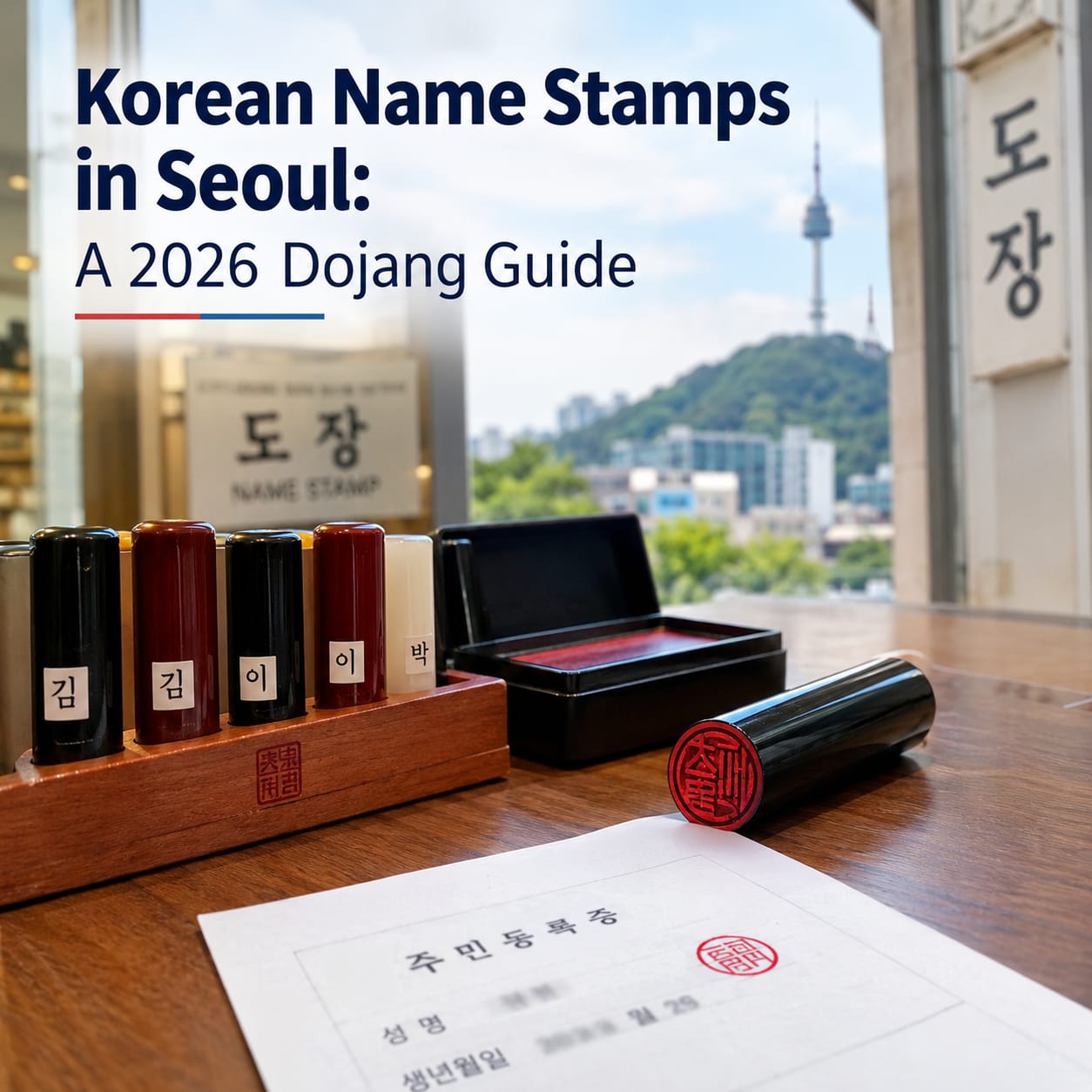
Korean Name Stamp in Seoul: The 2026 Dojang Guide
Looking for a unique souvenir from South Korea that is personal, useful, and connected to Korean culture? A Korean name stamp, known as a dojang (도장), is worth considering.
A dojang is a traditional Korean seal or stamp used to represent a person’s name or identity. Today, visitors can find customized name stamps and hands-on seal-carving experiences in Seoul, particularly in Insadong, an area well known for traditional crafts and cultural shopping.
For tourists, a custom dojang is best treated as a personalized cultural souvenir. It is important, however, not to confuse an ordinary souvenir stamp with a legally registered Korean seal used for official administrative purposes.
This guide explains what a dojang is, where to get one in Seoul, how customization works, what tourists should know about prices and registration, and how to make the experience part of an afternoon in Insadong.
Key Takeaways
- Dojang (도장) is a Korean seal or stamp traditionally used to represent a person’s name or identity.
- Insadong is one of the easiest areas in Seoul to find traditional seal and craft experiences.
- The official Seoul tourism guide currently lists Saegimsori at 33 Insadong-gil as a customized name-stamp shop.
- Korea Tourism Organization currently lists Yhlayuen Jeongak Academy in Insadong for Hangeul hand-carved seal experiences.
- Tourists can buy a customized souvenir stamp without becoming part of Korea’s official seal-registration system.
- A registered ingam (인감) is different from an ordinary decorative or souvenir dojang.
- Prices vary according to material, size, design, and whether you purchase a finished stamp or take a workshop, so it is better to confirm the current price directly with the provider.
- A Hangeul version of your name can make the souvenir especially memorable.
Quick Facts
| Detail | Information |
|---|---|
| Korean term | 도장 (dojang) |
| Meaning | Seal or stamp |
| Popular Seoul area | Insadong |
| Suitable for tourists | Yes |
| Custom name options | Vary by shop or workshop |
| DIY carving | Available at selected workshops |
| Official seal registration | Separate administrative process |
| Current listed shop | Saegimsori |
| Current listed workshop | Yhlayuen Jeongak Academy |
What Is a Korean Dojang?
A dojang is a seal or stamp used to leave an individual’s name or another inscription on paper.
Korean seals have a long cultural and administrative history. They have been used in connection with documents, artworks, official functions, and personal identification. Korea Tourism Organization describes the traditional dojang as a tool that continues to be used today in Korea, including for official documents and artworks.
For travelers, however, the most interesting part is the customization.
Instead of buying a generic souvenir, you can choose a name or inscription and have it carved into a small seal. Depending on the workshop or shop, you may be able to select the material, lettering style, and design.
You can then use the finished stamp in a travel journal, scrapbook, artwork, stationery, or simply keep it as a personal reminder of your trip.
Dojang vs. Ingam: What Is the Difference?
This distinction is important.
The word dojang can refer broadly to a seal or stamp. An ingam is associated with Korea’s official seal-registration system.
A person does not automatically receive a legally registered ingam simply by purchasing a customized stamp from a craft shop.
Korean law provides an official system for seal registration and seal certificates. The rules also cover foreign nationals who have completed the required foreigner registration in Korea.
Government24 also provides official services related to seal certificates and personal-signature verification.
What does this mean for tourists?
If you are visiting Seoul for several days or weeks, your customized dojang is normally a souvenir and cultural craft item.
You can use it for personal and creative purposes, but you should not assume that it can replace a registered seal or another legally required form of identification on an official transaction.
What about foreign residents?
Foreign residents who need an officially registered seal should check the current requirements with the appropriate Korean administrative authority.
The process for an official seal is separate from buying a personalized stamp as a tourist.
Why Insadong Is a Great Place to Get a Dojang
Insadong is one of Seoul’s best-known destinations for traditional crafts, galleries, cultural products, tea houses, and souvenirs.
It is also home to Saegimsori, which is currently listed by the official Seoul tourism website as a customized name-stamp shop.
According to the current Seoul tourism listing, Saegimsori is located at:
33 Insadong-gil, Jongno-gu, Seoul
The listing also provides current opening information and describes the shop as offering customized name stamps in different materials and designs.
Because shop schedules can change, check the latest listing before visiting.
Where Can You Get a Korean Name Stamp in Seoul?
Saegimsori
Saegimsori is a convenient choice for travelers who mainly want to purchase a customized name stamp.
The official Seoul tourism listing currently provides the following information:
| Information | Details |
|---|---|
| Location | 33 Insadong-gil, Jongno-gu, Seoul |
| Area | Insadong |
| Type | Customized name-stamp shop |
| Customization | Name and design options |
| Nearest subway area | Jongno 3-ga area |
| Current source | Official Seoul tourism listing |
Prices are not universal, so ask for the current price of the exact material and design you want.
Yhlayuen Jeongak Academy
For a more hands-on experience, Korea Tourism Organization currently lists Yhlayuen Jeongak Academy in Insadong for Hangeul hand-carved seal experiences.
The current VisitKorea listing gives the location as:
2F, Unit 202, 34 Insadong-gil, Jongno-gu, Seoul
The listing also provides operating information and contact details. Since workshop schedules and reservations may change, check the current VisitKorea information or contact the venue before making a special trip.
How to Get a Custom Korean Name Stamp
The exact process varies between businesses, but a typical experience looks like this.
1. Choose a shop or workshop
Decide whether you want:
- A finished custom stamp
- A traditional craft-shop experience
- A DIY carving workshop
Insadong is a convenient place to compare options.
2. Decide what you want engraved
Ask whether the provider can make your stamp using:
- Your name in Hangeul
- Roman letters
- Hanja, where appropriate
- A short word or phrase
- A decorative design
Available choices depend on the provider.
3. Choose the material
Different shops may offer different materials, including wood and stone.
The material can affect the final cost, appearance, and durability.
Do not assume that a particular material or price is available at every shop.
4. Check the spelling carefully
This is especially important when converting a foreign name into Hangeul.
Before the carving starts, check:
- The spelling
- The lettering style
- The orientation
- The overall layout
Once the stamp has been carved, correcting a mistake may require making a new one.
5. Carving and finishing
At a traditional shop, a craftsperson may complete the stamp for you.
At a DIY workshop, you may be shown how to transfer and carve the design yourself.
Korea Tourism Organization currently promotes Hangeul hand-carved seals as a cultural experience, making this a good option for travelers who want more than a simple shopping stop.
How Much Does a Korean Name Stamp Cost?
There is no single standard 2026 price for every Korean name stamp.
The final cost can vary depending on:
- Material
- Size
- Carving complexity
- Design
- Handmade or machine-assisted production
- Workshop participation
- Additional decorative work
- Packaging or accessories
Older travel articles sometimes quote a fixed price such as ₩30,000, but that should not be treated as a universal 2026 price.
What should you ask the shop?
Before ordering, ask:
“How much is this exact design and material?”
For a workshop, also ask whether the listed price includes the materials, instruction, finished stamp, packaging, and any additional design work.
This is a much safer way to budget than relying on a price published in an older blog post.
Can Tourists Buy a Korean Name Stamp?
Yes.
You do not need to be a Korean citizen simply to purchase a personalized souvenir stamp.
A visitor can purchase a customized dojang from a craft shop or participate in a seal-carving experience.
The important point is that purchasing a dojang is different from registering an official seal.
The official seal-registration system has separate administrative requirements. Korean law also provides rules concerning foreigners who have completed the relevant registration in Korea.
Can You Put Your English Name on a Dojang?
Often, yes, but the available options depend on the shop.
Hangeul
Your name can be represented phonetically in Korean.
For many international travelers, this is the most attractive option because it gives the souvenir a clear connection to Korean language and culture.
Roman letters
Some businesses may offer Roman-letter designs, although the amount of space on a small stamp can make longer names difficult to arrange.
Hanja
Some traditional seal designs use Chinese characters, known in Korean as hanja.
If you choose this option, do not select characters simply because they look attractive. Ask a knowledgeable Korean speaker or the craftsperson to explain the meaning and suitability of the characters.
Are Dojang Still Used in Korea?
Yes, although their role should not be exaggerated.
Dojang remain part of Korean cultural and administrative practice, and traditional seals continue to be used in contexts such as documents and artworks.
At the same time, modern Korea also uses handwritten signatures and electronic systems.
Korean law provides a personal-signature verification system that can be used in applicable situations instead of relying exclusively on traditional seal procedures.
So it would be misleading to say that modern Koreans use a physical stamp for everything.
A better description is that seals remain an established part of Korean culture and certain administrative practices, alongside signatures and digital methods.
What About the Claim That Nearly 100% of Korean Adults Own a Dojang?
You may see this claim repeated online, but it should not be presented as a fact without credible evidence.
There is no reliable current source supporting the statement that nearly 100% of Korean adults own or use a dojang.
That statistic has therefore been removed from this guide.
Dojang are culturally significant and remain in use, but the popularity of a tradition should not be confused with a precise nationwide ownership percentage.
A Brief History of Korean Seals
Korea has a long history of seal use, including royal and state seals.
Joseon-period royal seals are well documented. Korea’s cultural heritage records include surviving royal seals associated with kings and royal authority, including the Daegunjubo, a seal dating to the reign of King Gojong.
It is also useful to distinguish documented history from mythology.
Korean foundation traditions include stories involving Hwanung, Dangun, and heavenly seals. These are important parts of Korean mythology and cultural tradition, but they should not be presented as straightforward archaeological proof that modern tourist dojang directly descend from those legendary objects.
The documented history of Korean seals is already rich enough to make the subject fascinating without overstating the connection.
What Can You Use a Dojang For?
A tourist dojang can be a fun addition to your everyday stationery and travel memories.
You can use it for:
- Travel journals
- Scrapbooks
- Personal stationery
- Artwork
- Handmade cards
- Letters
- Sketchbooks
- Korea-themed crafts
- Gifts
A personalized stamp is especially nice because it carries your own name, rather than the name of a city or attraction.
VisitKorea currently presents Hangeul hand-carved seals as personalized keepsakes and gifts, reinforcing their appeal as a cultural experience for visitors.
What About Traditional Red Seal Paste?
Traditional Korean seals are commonly associated with red seal paste, often called inje (인주).
The appropriate ink or paste can depend on the material and style of your stamp.
When you buy your dojang, ask the seller which ink or paste is suitable for it and how it should be stored.
For a tourist souvenir, there is no need to buy a particular product simply because a blog recommends it. The easiest approach is to follow the manufacturer’s or craftsperson’s instructions.
How to Care for Your Dojang
A little care will help keep your stamp looking good.
Keep it dry
Avoid soaking wooden or porous materials in water.
Clean it gently
If ink remains in the carved lines, use the cleaning method recommended by the maker. Avoid aggressive scraping that could damage the carved surface.
Store it safely
A small pouch or case can help protect the stamp when you are traveling.
Take extra care with registered seals
An officially registered seal is a different matter. If you are a resident using a registered ingam, follow the relevant Korean administrative procedures if it is lost or needs to be replaced. Official Government24 services provide information on seal-related procedures.
What Should You Ask Before Buying?
Before you pay, ask these simple questions:
- How much is this exact stamp?
- What material is it?
- Can you write my name in Hangeul?
- Can I check the spelling before carving?
- How long will it take?
- Can I collect it later?
- Is a case included?
- What ink should I use?
- Can I carve it myself?
- Do I need a reservation?
These questions can save you time and prevent misunderstandings.
Common Mistakes to Avoid
Assuming every dojang is legally registered
A decorative souvenir stamp is not automatically an official registered seal.
Relying on an old price
Prices can change. Confirm the current amount before ordering.
Choosing Hanja without checking the meaning
A visually attractive character may not mean what you think it does.
Not checking your name
Always review the Hangeul or Roman-letter spelling before carving begins.
Assuming old opening hours are still correct
Business hours can change, so check the latest official listing before visiting. The official Seoul tourism listing is a useful starting point for Saegimsori.
Believing unsupported statistics
Claims such as “almost every Korean adult owns a dojang” should not be repeated unless backed by credible data.
Planning a Dojang Afternoon in Insadong
A visit to a Korean stamp shop can easily become part of a larger Insadong itinerary.
Start with Insadong-gil
Walk through the main street and browse traditional craft shops, galleries, and cultural stores.
Make your stamp
Choose a finished customized stamp or take part in a hand-carving experience.
Explore nearby craft shops
Insadong is a good place to look for Korean ceramics, stationery, traditional crafts, souvenirs, and small artworks.
Stop for Korean tea
After carving your stamp, slow down at one of the area’s traditional tea houses.
Finish with food
You can round out the afternoon with Korean snacks or a meal nearby.
The result is much more memorable than rushing into a shop, buying a souvenir, and leaving immediately.
Is a Korean Name Stamp a Good Souvenir?
For many travelers, yes.
A dojang is:
- Small enough to pack easily
- Personal
- Reusable
- Connected to Korean culture
- Different from typical mass-produced souvenirs
The best part is the customization.
You are not simply bringing home something that says “Seoul.” You are bringing home an object made around your own name.
VisitKorea currently presents Hangeul hand-carved seals as personalized keepsakes and gifts, reinforcing their appeal as a cultural experience for visitors.
Frequently Asked Questions
1. What is a Korean name stamp called?
A Korean name stamp is generally called a dojang (도장).
2. Can tourists buy a dojang in Seoul?
Yes. Tourists can purchase customized souvenir stamps in Seoul, including in Insadong. Saegimsori is currently listed by the official Seoul tourism guide as a customized name-stamp shop.
3. Where is the best place to get a Korean name stamp in Seoul?
Insadong is one of the most convenient areas because it has many traditional craft businesses and cultural experiences. Saegimsori and the Hangeul seal experience listed by VisitKorea are two current options to investigate.
4. How much does a Korean name stamp cost?
There is no universal 2026 price. Cost depends on the material, size, design, and whether you purchase a finished stamp or join a workshop.
5. Can foreigners put their name on a Korean stamp?
Yes, depending on the provider. You may be able to use Hangeul, Roman letters, or other lettering options.
6. Can tourists use a dojang as an official signature?
Do not assume so. A tourist souvenir stamp is not automatically a legally registered seal.
7. What is the difference between a dojang and an ingam?
Dojang is the general term for a seal or stamp. An ingam is associated with Korea’s official seal-registration system.
8. Can foreign residents register a seal in Korea?
Foreign residents who meet the relevant registration requirements can use Korea’s official seal-registration system. The exact requirements depend on their circumstances and should be confirmed with the appropriate government office.
9. Can I make my own Korean name stamp?
Yes. Selected cultural workshops offer hand-carved seal experiences. VisitKorea currently lists a Hangeul hand-carved seal experience in Insadong.
10. Should I use Hangeul or English letters?
Hangeul is a popular choice for travelers who want a stronger connection to Korean culture, while Roman letters may make your name easier to recognize internationally.
11. Is a Korean name stamp still relevant today?
Yes, seals remain part of Korean cultural and certain administrative practices, while signatures and electronic systems are also widely used.
12. Is a dojang a good Korean souvenir?
For travelers who enjoy personalized and cultural souvenirs, a dojang can be an excellent choice. It is compact, personal, and connected to Korea’s long seal-making tradition.
Final Thoughts
A Korean name stamp offers something that many ordinary souvenirs do not: personalization.
In Seoul, Insadong is a natural place to explore this tradition, whether you want a finished custom stamp or a hands-on Hangeul carving experience. Current official tourism listings provide useful starting points for both options.
Before buying, check the current price, confirm the spelling of your name, and ask exactly what is included. Most importantly, remember that a souvenir dojang is different from an officially registered Korean seal.
For an international traveler, that combination of craftsmanship, language, history, and personalization is what makes a dojang such a memorable piece of Korea to take home.
More traditional Korea guides: Explore our modern hanbok guide for Korean fashion and palace visits, and our lesser-known hanok villages guide for traditional architecture and cultural travel.
Leave a Reply