
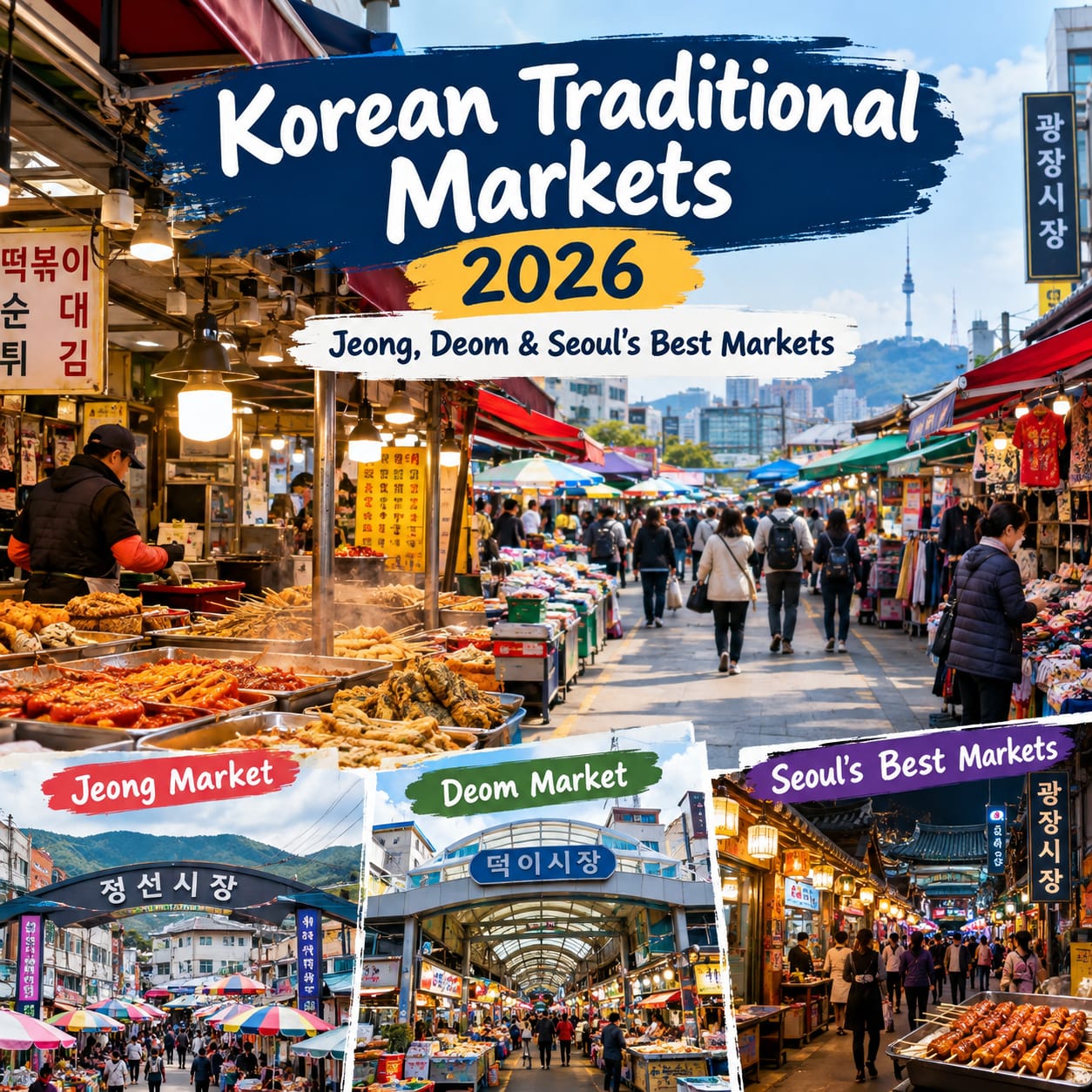
Seoul’s traditional markets offer something that polished shopping streets cannot: food, small businesses, local routines, and direct human interaction in one place.
This 2026 guide focuses on three well-known Korean traditional markets in Seoul: Gwangjang, Tongin, and Mangwon. You will find what to eat, current practical details, market etiquette, and the difference between jeong and deom.
The key idea is simple. Do not visit a market expecting a scripted cultural experience. Go to eat, explore, and observe everyday Seoul life.
Market hours, vendor schedules, prices, menus, and payment methods can change. Check the latest official listing before visiting.
Korean Traditional Markets at a Glance
| Market | Best for | Typical listed hours |
|---|---|---|
| Gwangjang | Iconic market food | Main market 09:00–18:00; food street 09:00–23:00 |
| Tongin | Dosirak Café | Market 07:00–21:00; individual stores vary |
| Mangwon | Neighborhood food | 10:00–21:00; individual stores vary |
Official tourism listings give these broad hours, but individual businesses can follow different schedules.
What Is Jeong?
Jeong (정) is a broad Korean concept linked with affection, warmth, attachment, sympathy, and emotional bonds that develop through relationships and shared experiences.
Jeong is not a special discount. It is not simply another word for kindness. It can describe feelings that grow over time between people, families, neighbors, friends, and communities.
A market can create opportunities for those everyday interactions. A vendor may remember a regular customer or chat with someone at a stall. Still, visitors should not label every friendly moment as jeong.
What Does Deom Mean?
Deom (덤) is much more specific. It means an extra item or amount added beyond what was purchased.
For example, a seller may add a few extra pieces of produce or a little more food. That extra is deom.
Deom can happen in a market, but it is never guaranteed. Do not ask for free food as though it is a tourist benefit. When a seller gives you something extra, a simple 감사합니다 (gamsahamnida) is enough.
Why Korean Traditional Markets Still Matter
Traditional markets face competition from supermarkets, department stores, convenience stores, and online shopping. They still remain important places for food, neighborhood commerce, and local experiences.
A 2026 KB Kookmin Card analysis of traditional-market card transactions reported that 2025 sales were 16% higher than in 2022, with transaction counts up 18%. These figures describe the card data covered by that analysis. They do not mean every market or merchant grew by the same amount.
The useful conclusion is more modest: traditional markets remain relevant, and food and local experiences continue to attract customers.
A Brief History of Seoul’s Markets
Gwangjang Market
Gwangjang Market was established in 1905. Seoul Metropolitan Government describes it as the country’s first permanent market. Today, it is especially famous for its food street, while the wider market also includes textiles, clothing, and other businesses.
Tongin Market
Tongin Market was established in June 1941. Its best-known visitor activity is the Dosirak Café, where visitors can build a lunchbox using tokens at participating stores.
Mangwon Market
Mangwon is a long-running neighborhood market in Mapo-gu. It is known for prepared foods, snacks, groceries, and the wider Mangwon-dong food scene. It also works well with a visit to nearby Mangwon Hangang Park.
Gwangjang vs. Tongin vs. Mangwon
| Market | Best for | Atmosphere | Signature experience |
|---|---|---|---|
| Gwangjang | First-time visitors | Busy and energetic | Food street |
| Tongin | Interactive food | Smaller and focused | Dosirak Café |
| Mangwon | Neighborhood exploring | Local and relaxed | Food plus Hangang |
1. Gwangjang Market
Best for: Iconic Korean market food and a lively atmosphere.
Gwangjang is often the easiest choice for first-time visitors. The food area is packed with familiar Korean market dishes, and many stalls serve portions that work well for sharing or sampling.
Address: 88 Changgyeonggung-ro, Jongno-gu, Seoul.
What to Try
- Bindae-tteok — savory mung-bean pancake.
- Mayak gimbap — small seaweed-and-rice rolls.
- Jeon — Korean savory pancakes.
- Hotteok — sweet griddle snack.
- Yukhoe — seasoned raw beef.
Choose a reputable food stall and use normal food-safety judgment, especially with raw dishes.
Gwangjang Market Hours
The current VisitKorea listing gives the main market as 09:00–18:00 and the food street as 09:00–23:00. The main market is listed as closed on Sundays. Individual businesses can differ.
Can You Pay by Card?
The current VisitKorea listing says cards are accepted. Still, carrying a small amount of Korean won is a useful backup for independent vendors.
2. Tongin Market
Best for: A market meal that feels like an activity.
Address: 18 Jahamun-ro 15-gil, Jongno-gu, Seoul.
Tongin is known for its Dosirak Café. The experience lets you buy tokens and choose food from participating stores before assembling a lunchbox.
How the Dosirak Café Works
- Go to the Dosirak Café area.
- Buy the current token set.
- Walk through the participating stalls.
- Choose foods you want.
- Return to the café area and eat your lunchbox.
The current tourism listing gives the café as open Wednesday–Monday, 11:00–15:00, with Saturday and Sunday extending to 16:00. It is listed as closed on Tuesdays and the third Sunday of each month. The market itself can remain open outside café hours.
What to Eat at Tongin
You may find rice dishes, jeon, tteokbokki, side dishes, vegetables, and other prepared foods. Tongin is also associated with gireum-tteokbokki, a pan-fried style of tteokbokki.
3. Mangwon Market
Best for: Neighborhood food and an easy Hangang combination.
Address: 27 Poeun-ro 6-gil, Mapo-gu, Seoul.
Mangwon feels different from the more famous tourist-heavy market experience. You can browse prepared foods, snacks, groceries, and small shops. The nearby Hangang park also makes it easy to turn the visit into a longer afternoon.
What to Try
- Dakgangjeong — sweet-savory crispy Korean fried chicken.
- Croquettes — fried snacks with different fillings.
- Tteokbokki — spicy-sweet rice cakes.
- Hotteok — sweet griddle snack.
Is Mangwon Closed on Monday?
The current Seoul tourism listing gives Mangwon Market as daily, 10:00–21:00, with individual store hours varying. That is more accurate than older blanket statements about a Monday closure.
How to Pay at Korean Traditional Markets
Do not assume every traditional market is cash-only. Payment options have expanded.
At the same time, vendor practices can differ. A simple strategy is card plus a small cash backup. This gives you flexibility without carrying a large amount of cash.
Traditional Market Etiquette
Greet the Vendor
A friendly 안녕하세요 (annyeonghaseyo) is enough.
Check the Price
When the price is unclear, ask before ordering.
Do Not Expect Deom
An extra item is a gesture, not an entitlement.
Say Thank You
감사합니다 (gamsahamnida) is always useful.
Keep Walkways Clear
Markets can be crowded. Step aside when checking your phone or translating a menu.
Ask Before Touching Food
Wait for the vendor to show you what you can pick up yourself.
Should You Haggle?
There is no universal rule that everything in a Korean market is negotiable.
For prepared food, accept the displayed price unless the seller says otherwise. For clothing, crafts, or other goods, polite negotiation may sometimes be possible.
Gwangjang and the Overcharging Controversy
Gwangjang Market has faced public criticism about prices and portions. In 2023, Seoul Metropolitan Government announced measures to improve pricing transparency, including clearer quantity or weight information, sample displays, monitoring, and merchant education.
The practical lesson is simple: check the price and portion before ordering. That advice applies anywhere.
How to Experience Jeong Without Expecting Free Food
Markets can create warm interactions, but you cannot manufacture jeong by memorizing a phrase.
Be friendly. Be patient. Order clearly. Respect the vendor. Say thank you.
If someone gives you a little extra, enjoy the gesture. That is deom. The wider feeling of human connection is closer to the idea of jeong.
What Should You Eat?
Market eating works well as a tasting experience. Try smaller portions instead of making every stop a full meal.
- Gwangjang: bindae-tteok, mayak gimbap, jeon, hotteok, and yukhoe.
- Tongin: build a Dosirak lunchbox and try gireum-tteokbokki.
- Mangwon: dakgangjeong, croquettes, tteokbokki, and other prepared snacks.
Which Market Should You Choose?
Choose Gwangjang if…
You want the classic, food-focused Seoul market experience.
Choose Tongin if…
You want an interactive lunch activity near Gyeongbokgung and Seochon.
Choose Mangwon if…
You want neighborhood food and an easy route toward the Han River.
A Simple Market Itinerary
Gwangjang + Jongno: Eat at the market, then explore nearby historic neighborhoods.
Tongin + Gyeongbokgung + Seochon: Visit during Dosirak Café hours, then continue sightseeing.
Mangwon + Hangang Park: Pick up snacks and continue toward the riverside park.
7 Mistakes to Avoid
- Expecting free food.
- Calling every friendly interaction jeong.
- Assuming every market is cash-only.
- Assuming every stall accepts every card.
- Forgetting that vendor hours vary.
- Ordering before checking the price.
- Trusting old market information without checking current listings.
Frequently Asked Questions
What is jeong in Korean culture?
Jeong is a broad concept linked with warmth, affection, attachment, sympathy, and relationships built through shared experiences.
What does deom mean?
Deom means an extra or free addition given beyond the goods already purchased.
Do market vendors give tourists free food?
Sometimes a seller may give an extra item. It is not guaranteed.
Is deom the same as jeong?
No. Deom refers to an extra item or amount. Jeong is a much broader emotional concept.
Which market is best for first-time visitors?
Gwangjang is usually the easiest starting point for iconic market food and atmosphere.
Which market is best for a neighborhood experience?
Mangwon is a strong choice, especially when paired with Mangwon-dong and Hangang Park.
Final Thoughts
Korean traditional markets are worth visiting because they combine food, commerce, neighborhood life, and human interaction.
Gwangjang is the classic food-market choice. Tongin adds the Dosirak Café experience. Mangwon is ideal for a more neighborhood-oriented outing.
Do not visit expecting free food or a perfect cultural moment. Check prices, carry some cash, respect the vendors, and enjoy what is actually happening around you.
Related guide: Hon-bap Seoul 2026: Eating Alone in Korea.
Official market information can change. Check the current Seoul or Korea Tourism Organization listing before your visit.
Leave a Reply