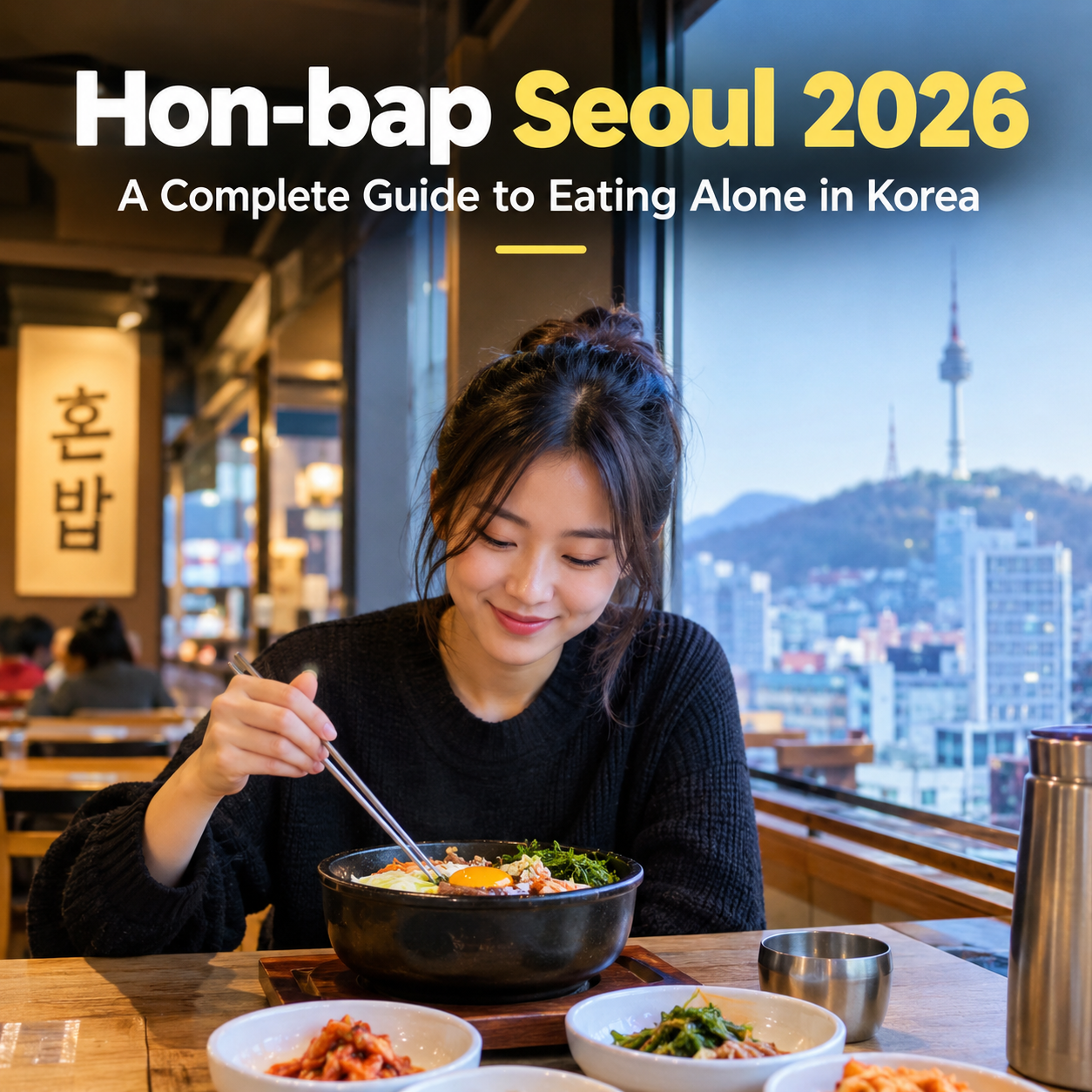
Solo Dining in Seoul: Hon-bap
Restaurants, Food & Apps (2026)
Traveling alone in Seoul does not mean missing out on Korean food.
In fact, solo dining in Seoul is easier than many first-time visitors expect. You can enjoy individual bowls of kalguksu, dumplings, Korean soups, market snacks, one-person shabu-shabu and even Korean BBQ without needing a travel companion.
In Korea, eating alone is commonly called hon-bap (혼밥). While some traditional restaurants still have minimum-order or minimum-serving rules, Seoul has a wide range of restaurants and dining formats that work well for one person.
For international travelers, 2026 has also brought useful changes to the digital side of dining. CATCHTABLE Global supports restaurant reservations and waitlists for international visitors without requiring a Korean phone number, while NAVER introduced passport verification in June 2026, allowing eligible foreign visitors to use supported NAVER Map booking, ordering and payment services without a Korean mobile number.
This guide covers where to eat alone in Seoul, what hon-bap means, how Korean BBQ minimum-order rules work, which foods are easiest for solo travelers, and which apps are useful in 2026.
2026 information note: Restaurant hours, menus, booking rules and app requirements can change. Check the current restaurant or platform listing before visiting. For household statistics, the latest official Statistics Korea figures available for this guide are from 2024, not 2026.
Is Solo Dining in Seoul Easy?
Yes.
Eating alone is particularly straightforward at restaurants that naturally serve individual portions.
The easiest choices are usually:
- Noodle restaurants
- Soup and rice restaurants
- Traditional markets
- Food courts and department-store dining areas
- Restaurants with counter seating
- Dedicated one-person restaurants
- Some solo Korean BBQ restaurants
The situation becomes more complicated at restaurants designed around shared dishes.
Korean BBQ is the most common example. Some restaurants have minimum-serving requirements, meaning one customer may need to order two portions or more. Other restaurants specifically cater to solo diners.
The important point is that there is no single rule that applies to every Korean restaurant.
What Is Hon-bap (혼밥)?
Hon-bap (혼밥) means eating alone.
The word combines hon (혼), meaning “alone,” with bap (밥), meaning rice or, more generally, a meal.
You may also encounter honjok (혼족), which refers more broadly to people who choose to do activities alone.
So:
Hon-bap = eating alone
Honjok = living or doing activities alone
For travelers, the practical takeaway is simple: you do not need to feel awkward about eating alone in Seoul. The main thing to check is the restaurant’s individual seating and ordering policy.
How Common Are One-Person Households in Seoul?
Solo dining is part of a broader change in Korean household patterns.
According to Statistics Korea, 1-person households reached approximately 8.04 million in 2024, representing 36.1% of households nationwide.
Seoul recorded an even higher share at 39.9%, the highest among Korean provinces and metropolitan areas in that dataset.
These are the latest official household figures available, but they are 2024 statistics rather than 2026 figures.
That distinction is important. A 2026 article should not imply that Statistics Korea has already published an official 2026 household percentage when the latest available dataset is 2024.
The figures nevertheless help explain why individual lifestyles and solo consumption are increasingly visible in Seoul.
Best Places to Eat Alone in Seoul
The best solo dining choices depend on what you want to eat.
| Place or dining style | Best for | Why it works for solo diners |
|---|---|---|
| Myeongdong Kyoja | Kalguksu and mandu | Individual dishes are easy to order |
| Hongojib, Myeongdong | Korean BBQ | Individual seating and personal grills |
| Gwangjang Market | Korean street food | Many stalls sell individual portions |
| Shabuchon by GBZ, Jamsil | Shabu-shabu | Specifically listed as a single-person restaurant |
| Department-store food halls | Variety | Many individual meal options |
| Noodle shops | Quick meals | Individual bowls are standard |
| Counter-seat restaurants | Fine dining | Seating naturally works for one |
1. Myeongdong Kyoja
Best for: Kalguksu and mandu
Myeongdong Kyoja is one of Seoul’s most convenient famous restaurants for solo travelers.
The restaurant is known for kalguksu, Korean knife-cut noodle soup, and mandu dumplings. Its individual dishes make it much easier to order a complete meal without needing a group.
The official Seoul tourism listing was edited on April 30, 2026, and currently lists the restaurant as open daily from 10:30 AM to 9:00 PM.
The Michelin Guide also lists Myeongdong Kyoja for its signature noodle and dumpling dishes.
Address:
29 Myeongdong 10-gil, Jung-gu, Seoul
Why solo travelers like it
You can walk in, order individual dishes and eat without needing to coordinate several shared menu items.
Because it is popular, however, you should expect busy periods and possible queues.
2. Hongojib in Myeongdong
Best for: Solo Korean BBQ
Hongojib is one of the more interesting options for travelers who specifically want Korean BBQ alone in Seoul.
A listing updated on August 14, 2026 describes Hongojib as a solo-friendly Korean BBQ restaurant with individual booth seating, personal grills and tablet ordering. The listed address is 40 Myeongdong 3-gil, Jung-gu, Seoul.
The restaurant is particularly useful because Korean BBQ can otherwise be one of the more difficult Korean foods for solo travelers.
Instead of trying to adapt a group-oriented restaurant to one person, you can choose a restaurant whose setup is already designed around individual dining.
Address:
40 Myeongdong 3-gil, Jung-gu, Seoul
Reported hours:
11:00 AM–1:00 AM
Because hours can change, confirm the current listing before visiting.
3. Gwangjang Market
Best for: Korean street food and casual eating
Gwangjang Market is one of the easiest places in Seoul to explore food alone.
The official Seoul tourism guide highlights popular foods including:
- Bindae-tteok
- Mayak gimbap
- Yukhoe
- Sundae
- Assorted jeon
Because many stalls sell individual or snack-sized portions, a solo traveler can try several foods without ordering an entire meal designed for a group.
Current hours
The official Seoul tourism listing currently gives:
General market: 9:00 AM–6:00 PM
Closed: Sundays
Food alley: 9:00 AM–11:00 PM
Individual vendors may keep different hours.
Address:
88 Changgyeonggung-ro, Jongno-gu, Seoul
Best strategy for solo travelers
Go with an appetite rather than a fixed meal plan.
Try one small dish, walk around, then stop at another stall. This is one of the easiest ways to experience several Korean foods without worrying about group-size requirements.
4. Shabuchon by GBZ at Lotte Department Store Jamsil
Best for: One-person shabu-shabu
Another useful option for solo diners is Shabuchon by GBZ at Lotte Department Store Jamsil Castle Plaza.
Current NOL World information describes it specifically as a single-person shabu-shabu restaurant. The listed address is 269 Olympic-ro, Songpa-gu, Seoul, and the current listing shows hours of 11:00 AM–8:00 PM.
This is a good example of why it is useful to look for restaurants specifically designed around individual diners instead of assuming that every Korean restaurant will have the same rules.
Address:
269 Olympic-ro, Songpa-gu, Seoul
Current listed hours:
11:00 AM–8:00 PM
Can You Eat Korean BBQ Alone in Seoul?
Yes — but check the restaurant first.
This is one of the biggest misconceptions about eating in Korea.
Some Korean BBQ restaurants have a minimum-serving requirement, such as two servings of meat. This does not necessarily mean that two people have to sit at the table, but the restaurant may require a minimum amount of food to be ordered.
Other restaurants are specifically designed for solo diners.
Look for restaurants offering:
- Individual seating
- Personal grills
- One-person portions
- Counter or booth seating
- Tablet ordering for individual customers
If a restaurant has a two-serving minimum, you can politely ask:
혼자 먹을 수 있어요?
Honja meogeul su isseoyo?
“Can I eat alone?”
You can then ask whether ordering the required two portions is acceptable for one customer.
The safest rule
Never assume that every BBQ restaurant has the same policy.
Check the restaurant’s current listing or ask staff before ordering.
Korean Restaurant Minimum-Order Rules Explained
There is no universal rule that every Korean restaurant requires two people.
Minimum-order policies are restaurant-specific.
You may encounter them more often at:
- Korean BBQ restaurants
- Shared stews
- Large hot pots
- Group-oriented restaurants
- Some seafood restaurants
Individual dishes are generally much easier for solo travelers.
The difference between a two-person minimum and a two-serving minimum is also important.
A restaurant may allow one customer to eat alone but require that customer to order two servings.
Another restaurant may not offer solo seating at all.
That is why checking the exact policy before visiting is better than relying on general travel advice.
Best Korean Foods to Eat Alone in Seoul
Not every Korean dish is equally convenient for one person.
| Korean food | Solo-friendly? | Why |
|---|---|---|
| Kalguksu | Excellent | Usually served as an individual bowl |
| Mandu | Excellent | Easy to order as a small portion |
| Mayak gimbap | Excellent | Small pieces are easy to share with yourself |
| Bindae-tteok | Good | Commonly available by individual serving |
| Bibimbap | Excellent | Designed as an individual meal |
| Soup and rice | Excellent | Normally served individually |
| Solo shabu-shabu | Excellent where offered | Personal pot is designed for one diner |
| Korean BBQ | Depends | Restaurant policy varies |
| Large hot pot | Less convenient | Usually intended for sharing |
| Large army stew | Less convenient | Often designed for groups |
For your first hon-bap meal, kalguksu, mandu, bibimbap, soup or market food are among the easiest choices.
Best Apps for Solo Dining in Seoul in 2026
The digital side of Korean dining has changed considerably.
Older travel articles often say that foreigners need a Korean phone number to use Korean reservation services.
That is no longer universally true.
In 2026, international visitors have several useful options.
CATCHTABLE Global
Best for: Restaurant reservations and waitlists
CATCHTABLE Global is one of the most useful restaurant-booking services for foreign visitors in Korea.
The Korea Tourism Organization’s current 2026 information says CATCHTABLE Global allows international users to create an account using Google, Apple or email, without a Korean phone number.
It also supports overseas-issued cards for reservation deposits, and the service is available in 20 languages.
CATCHTABLE Global supports:
- Restaurant reservations
- On-site waitlists
- Remote waitlists
- Restaurant information
- Menu information
- International-language support
The platform is especially useful for popular restaurants where a walk-in visit may involve a long wait.
Important
CATCHTABLE Global does not mean every restaurant accepts solo reservations.
Always check the individual restaurant’s:
- Party-size requirements
- Available dates
- Deposit
- Cancellation policy
- Arrival requirements
NAVER Map in 2026
Best for: Restaurant discovery, maps, bookings and local information
One of the biggest changes for foreign travelers in 2026 is NAVER’s new passport verification system.
NAVER announced on June 9, 2026 that foreign users can verify their identity using a passport and access supported NAVER Map booking, ordering and payment services without a Korean mobile phone number.
This makes NAVER Map much more useful for international travelers.
You can use it to:
- Search for restaurants
- Check restaurant locations
- View local information
- Find supported reservations
- Use supported ordering services
- Navigate around Seoul
2026 update
Do not publish the outdated blanket statement that foreigners need a Korean phone number to use NAVER services.
The new passport-verification system specifically expands access for foreign visitors.
Shuttle
Best for: International-friendly food delivery
Shuttle provides food delivery and pickup services in Korea and is particularly useful for travelers who prefer an English-language ordering experience.
Its current website says the service operates across Korea, including Seoul, and supports 13+ languages. It also states that international cards are accepted.
Current account information shows that Shuttle collects mobile-number information during registration, so older claims that Shuttle is simply an “email-only” service should be avoided.
Current listed service hours are:
Monday–Sunday: 10:00 AM–11:00 PM
Availability depends on the delivery area and participating restaurant.
Baemin
Best for: Korean food delivery
Baemin is one of Korea’s major food-delivery platforms and now has a traveler-facing English service.
Its current global page promotes delivery to:
- Hotels
- Airbnb accommodations
- Areas near the Han River
It also offers real-time delivery tracking and pickup.
This means the old blanket statement that tourists simply cannot use Baemin is no longer accurate.
However, payment, account and delivery requirements can vary, so travelers should follow the current checkout process rather than relying on old “tourist hacks.”
CATCHTABLE Global vs NAVER Map vs Shuttle vs Baemin
| Service | Main purpose | Best for |
|---|---|---|
| CATCHTABLE Global | Reservations and waitlists | Popular restaurants |
| NAVER Map | Maps, restaurant discovery,
supported booking/order services |
Local restaurant research |
| Shuttle | Delivery and pickup | International-friendly delivery |
| Baemin | Food delivery and pickup | Korean delivery experience |
There is no single app that works for every restaurant in Seoul.
Your best approach is to use CATCHTABLE Global or NAVER Map for reservations and restaurant discovery, then use a delivery service when you want food brought to your accommodation.
How to Book a Restaurant in Seoul Without a Korean Phone Number
Step 1: Search CATCHTABLE Global
Look up the restaurant and check whether reservations or remote waitlisting are available.
CATCHTABLE Global specifically supports international account creation without a Korean phone number.
Step 2: Check NAVER Map
Search the same restaurant on NAVER Map.
Eligible foreign users can now use passport verification for supported booking, ordering and payment services without a Korean mobile number.
Step 3: Check the Restaurant’s Own Rules
Before confirming a booking, look for:
- Minimum party size
- Minimum order
- Reservation deposit
- Cancellation deadline
- No-show conditions
- Late-arrival rules
Step 4: Save a Backup Restaurant
Popular Seoul restaurants can become fully booked.
Saving one nearby alternative is an easy way to avoid losing an evening because of a full reservation list.
Seoul Restaurant No-Show Rules in 2026
This is another area where older online information can be misleading.
South Korea’s revised Consumer Dispute Resolution Standards took effect on December 18, 2025.
For restaurant reservation no-shows, the revised standards distinguish between ordinary restaurants and reservation-based restaurants.
The guideline allows:
Ordinary restaurants: up to 20% of the total amount
Reservation-based restaurants: up to 40% of the total amount
Reservation-based restaurants include businesses such as certain omakase and fine-dining restaurants where food and ingredients are prepared specifically around advance reservations.
Large group reservations or large-volume orders can also fall under the stronger standard when the relevant conditions are met.
Most importantly, 40% is not an automatic fee charged to every person who misses a restaurant reservation.
The rules require the relevant conditions to be disclosed to customers in advance.
What travelers should check
Before confirming a reservation, look at:
- Deposit amount
- Cancellation deadline
- No-show fee
- Late-arrival rules
- Refund conditions
This is particularly important for expensive restaurants.
Do Tourists Need an ARC or Foreign Residence Card?
No.
A tourist does not need a Korean Foreign Residence Card simply to walk into a restaurant and eat.
The confusion usually comes from online services that use identity or phone verification.
In 2026, international access is broader:
- CATCHTABLE Global supports international restaurant reservations without a Korean phone number for supported bookings.
- NAVER introduced passport verification for foreign visitors, allowing supported booking, ordering and payment features without a Korean mobile number.
This still does not mean every Korean website, app, kiosk or restaurant uses the same verification system.
Can You Eat Alone at Fine-Dining Restaurants in Seoul?
Yes, but this is one area where you should check carefully before booking.
Counter seating can make fine dining particularly suitable for one person, but a Michelin star, Bib Gourmand listing or popular restaurant status does not automatically mean solo reservations are accepted.
Look at the restaurant’s current booking page for:
- Party-size options
- Counter seating
- Minimum spending
- Reservation deposits
- Cancellation conditions
CATCHTABLE Global can help identify supported reservations, but the individual restaurant’s booking conditions always take priority.
A 12-Hour Seoul Solo Food Itinerary
Here is a practical one-day plan for travelers who want to combine sightseeing and hon-bap.
| Time | Area | Plan |
|---|---|---|
| 10:30 AM | Myeongdong | Kalguksu and mandu at Myeongdong Kyoja |
| 12:30 PM | Myeongdong / Central Seoul | Walk and sightseeing |
| 2:00 PM | Gwangjang Market | Bindae-tteok and mayak gimbap |
| 4:00 PM | Seongsu | Cafés and shopping |
| 7:00 PM | Myeongdong or another convenient district | Solo Korean BBQ |
Myeongdong Kyoja currently lists hours of 10:30 AM–9:00 PM daily, while the official Gwangjang Market listing gives separate hours for the general market and food alley.
Because restaurant hours can change, check the live listing on the day of your visit.
Practical Tips for Eating Alone in Seoul
Choose Individual Portions
The easiest restaurants are those where individual servings are already normal.
Ask About BBQ Minimums
Do not assume that every Korean BBQ restaurant requires two people.
Ask whether one person can order the restaurant’s required minimum.
Eat Slightly Earlier or Later
Popular restaurants can become crowded around traditional lunch and dinner periods.
Eating outside peak periods can sometimes make the experience easier.
Use CATCHTABLE Global for Popular Restaurants
For reservations and remote waitlists, CATCHTABLE Global is particularly convenient for foreign visitors.
Keep NAVER Map Installed
NAVER Map is increasingly useful for foreign travelers, especially following the 2026 passport-verification update.
Keep Your Hotel Address Ready
This is especially important when ordering food delivery.
Read Cancellation Terms
Never assume that every restaurant uses the same cancellation policy.
Frequently Asked Questions
Is it easy to eat alone in Seoul?
Yes.
Solo dining is particularly easy at noodle shops, soup restaurants, traditional markets, food courts and restaurants designed for individual diners.
Restaurant policy matters more than any general rule about eating alone.
What is hon-bap in Korea?
Hon-bap (혼밥) means eating alone.
It combines the Korean words hon for “alone” and bap for rice or a meal.
Is solo dining common in Seoul?
Solo lifestyles are increasingly visible in South Korea.
Statistics Korea reported that one-person households represented 36.1% of households nationwide in 2024, while Seoul recorded 39.9%. These remain the latest official household figures available for this guide.
Can you eat Korean BBQ alone in Seoul?
Yes.
Some restaurants require multiple servings, while others are specifically designed for solo diners.
Restaurants such as Hongojib in Myeongdong are examples of places currently listed as solo-friendly with individual seating and personal grills.
What are the easiest Korean foods to eat alone?
Kalguksu, mandu, bibimbap, soups, rice dishes, market snacks and individual shabu-shabu are among the easiest options.
Do tourists need a Korean phone number to make restaurant reservations?
Not always.
CATCHTABLE Global supports international users without a Korean phone number for supported reservations. NAVER also introduced passport verification in June 2026 for foreign users accessing supported NAVER Map booking, ordering and payment services.
Can foreigners use NAVER Map in Korea?
Yes.
NAVER introduced passport verification in June 2026 so eligible foreign visitors can access supported NAVER Map reservations, ordering and payment services without a Korean mobile number.
Can tourists use CATCHTABLE Global?
Yes.
CATCHTABLE Global is specifically designed for international travelers and supports account creation through Google, Apple or email without requiring a Korean phone number. Overseas cards can also be used for supported reservation deposits.
Can tourists order food delivery in Seoul?
Yes.
Shuttle offers international-oriented food delivery and pickup services and supports 13+ languages and international cards. Baemin also operates a traveler-facing English service promoting delivery to hotels, Airbnb accommodations and other locations.
Is there a 40% restaurant no-show fee in Korea?
There can be a guideline allowing up to 40% for reservation-based restaurants, while the standard for ordinary restaurants is up to 20%.
The 40% figure is not a universal automatic charge for every restaurant reservation. The relevant policy must meet the applicable conditions and be disclosed in advance.
Do tourists need an ARC to eat at restaurants in Seoul?
No.
A Foreign Residence Card is not required simply to dine at a restaurant.
Some digital services may have their own verification requirements, but international options have expanded significantly in 2026.
What are the best restaurants for solo travelers in Seoul?
Good starting points include:
Myeongdong Kyoja for kalguksu and mandu
Hongojib for solo Korean BBQ
Gwangjang Market for Korean street food
Shabuchon by GBZ for single-person shabu-shabu
Always verify current opening hours and restaurant policies before visiting.
Final Thoughts: Solo Dining in Seoul in 2026
Solo dining in Seoul is easier than many travelers expect.
You do not need to travel with a group to enjoy Korean food.
Start with restaurants serving individual portions, such as noodle shops, soup restaurants and market stalls. When you want Korean BBQ, check the restaurant’s minimum-serving policy or choose a restaurant specifically designed for solo diners.
The digital side of dining has also become more convenient for foreign travelers in 2026.
CATCHTABLE Global can handle reservations and waitlists at supported restaurants without requiring a Korean phone number.
NAVER Map is increasingly useful to international travelers following NAVER’s introduction of passport verification for foreign visitors in June 2026.
For delivery, Shuttle and Baemin provide traveler-facing options, although requirements and availability vary by restaurant and location.
And when booking a restaurant, do not assume that every no-show policy is the same. Since December 18, 2025, the applicable consumer-dispute standards distinguish between ordinary restaurants and reservation-based restaurants, with guideline ceilings of 20% and 40% respectively under the relevant conditions.
The biggest lesson is simple:
Do not believe blanket statements about dining in Korea.
Not every restaurant requires two people.
Not every app requires a Korean phone number.
Not every tourist needs a Korean residence card.
And not every missed reservation automatically results in a 40% penalty.
Seoul has a huge range of dining experiences for people traveling alone. Whether you want kalguksu in Myeongdong, street food at Gwangjang Market, solo Korean BBQ, one-person shabu-shabu or Korean food delivered to your hotel, you can build a great Seoul food itinerary entirely around yourself.
That is the appeal of hon-bap: choose what you want, eat when you want, and enjoy Seoul at your own pace.


Leave a Reply