
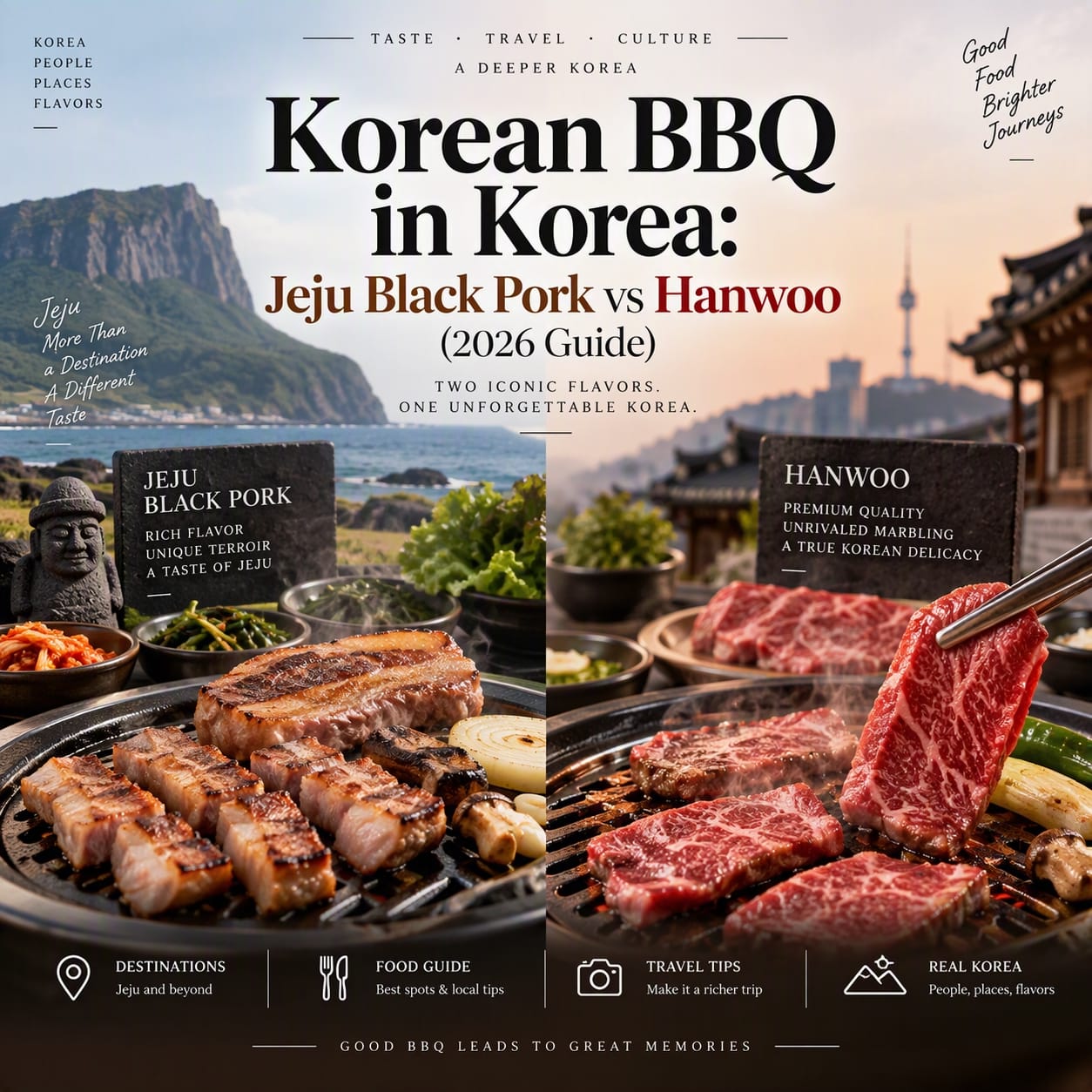
Planning a Korean barbecue meal and deciding between Jeju black pork and Hanwoo beef? Both are worth trying, but they offer different experiences. Jeju black pork is associated with the island’s native pig breed, hearty flavor, and local accompaniments such as fermented anchovy sauce. Hanwoo is Korean beef graded under a national system, with higher grades generally showing more intramuscular fat.
There is no single “best” choice. Your budget, appetite, and itinerary may decide it for you. Here is how to compare them—and avoid outdated prices or restaurant advice.
Jeju black pork vs Hanwoo: which should you order?
Choose Jeju black pork for a shareable barbecue with rich pork, leafy wraps, and local dipping sauces. Choose Hanwoo if you want to compare Korean beef cuts and grades or make the meal a special occasion.
The labels describe different things: Jeju black pork refers to a native local pig breed and regional food tradition; Hanwoo is a Korean cattle breed whose beef is graded by quality. Neither label guarantees one fixed flavor, price, or quality level at every restaurant.
Jeju black pork: what makes it distinctive?
Jeju black pork, or heukdwaeji, is one of Jeju Island’s best-known food specialties. VisitKorea describes the native pig as smaller and slower-growing than commercial breeds, with fat known for its chewy texture. Grilled pork is often served with meljeot, a salted, fermented anchovy sauce, or jari-jeot. Lettuce, perilla leaves, garlic, and ssamjang are familiar accompaniments. VisitKorea’s Jeju food guide explains the local pairing.
One distinction matters: the protected native breed and pork sold under a “Jeju black pork” menu label are not automatically the same thing. Jeju black pig is designated Natural Monument No. 550, with a protected population and breeding management. Commercial production also includes crossbreeding and other systems. If the exact breed or certification matters, ask the restaurant. See the Korea Heritage Service entry.
Jeju’s traditional dottongsi—a household toilet and pigpen system—is part of the island’s agricultural history, not a description of modern commercial farming. Visit Jeju’s overview of tongsi gives cultural context.
For a current restaurant example, Visit Jeju lists Sukseongdo Hamdeok at 40 Hamdeok-ro, second floor, in Jocheon-eup, Jeju City. The listing describes aged pork; check its latest hours, booking options, and menu before traveling. See the Visit Jeju listing.
Hanwoo: understand the grade before the price
Hanwoo is beef from Korean native cattle. It is not simply “Korean Wagyu,” and taste is personal: some diners prefer highly marbled cuts, while others like leaner cuts with a stronger beef flavor.
Korea’s grading system considers more than marbling. It assesses intramuscular fat, meat and fat color, texture, and maturity. 1++ is the highest quality grade; this grade can also carry a marbling score of 7, 8, or 9. Comparing prices by grade and cut is more useful than treating every Hanwoo menu as equivalent. The Hanwoo Beef Export Promotion Portal explains the grading criteria.
Hoengseong in Gangwon State is especially associated with Hanwoo, including its regional beef brand and annual festival. Hanwoo restaurants are also found throughout Korea, including Seoul. VisitKorea’s Hoengseong Hanu Festival guide provides regional context.
In Seoul, Born and Bred is one option near Majang-dong’s meat-market district. Its dining formats vary, so check current details before choosing a tasting menu or à la carte meal. The MICHELIN Guide listing describes its different dining concepts.
What does Hanwoo cost in 2026?
Prices depend on cut, grade, retailer, restaurant, and portion size. As a current retail reference, aT’s KAMIS price page listed 1++ tenderloin per 100 g on October 1, 2026 at ₩23,108 in large supermarkets, ₩16,418 in supermarkets, and ₩17,273 at butcher shops. These are retail prices for one cut—not restaurant barbecue prices. Menus and portions differ, so check the latest data and restaurant menu before budgeting. View KAMIS retail-price data.
An often-repeated 18.4% figure needs context: it referred to the year-on-year increase in the January 2026 wholesale price for Hanwoo steers, not a universal increase in restaurant prices. Separately, the Ministry of Agriculture reported 22 African swine fever cases through March 3, 2026. Those figures alone do not establish that disease outbreaks caused a particular restaurant’s prices. For budgeting, check current menus rather than extrapolating wholesale headlines.
Jeju black pork prices also vary by cut, serving size, and restaurant. Check whether the menu lists a price per person, serving, or 100 g, and whether rice or other sides cost extra.
How to choose a restaurant and order
Before you go, check the restaurant’s current menu, hours, location, and booking rules. Popular restaurants may use reservations or waiting lists, but there is no single booking system used everywhere.
CatchTable Global can help at participating restaurants. VisitKorea says international visitors can create an account through Google or Apple without a Korean phone number and use foreign-issued cards for eligible payments. Availability depends on the restaurant: some offer remote waitlists, while others require guests to join in person. Read VisitKorea’s CatchTable Global guide.
At a barbecue restaurant, check whether staff grill the meat or expect guests to cook it. If staff are handling the grill, let them guide the timing. For pork, taste a bite with salt first, then try the restaurant’s sauces and wraps. If meljeot is offered, start with a small dip: its fermented anchovy flavor is savory and intense.
Traveling alone? See our Hon-bap Seoul guide for solo-friendly restaurant advice.
Jeju black pork vs Hanwoo: at a glance
| What you want | Try |
|---|---|
| A hearty pork barbecue with Jeju accompaniments | Jeju black pork |
| A meal focused on Korean beef cuts and grades | Hanwoo |
| A regional food trip outside Seoul | Jeju for black pork; Hoengseong for Hanwoo |
| A special-occasion meal in Seoul | Compare current Hanwoo tasting and à la carte menus |
| A reliable budget estimate | Check the current menu and serving weight before booking |
Frequently asked questions
Is Jeju black pork the same as ordinary pork?
The term is associated with Jeju’s native black pig and the island’s food culture. Commercial products and restaurant sourcing can vary, so ask the restaurant if you need to know the exact breed or certification.
Is 1++ Hanwoo always the best choice?
It is the highest Korean quality grade, but “best” depends on the cut and your taste. Higher marbling can make a richer bite; a leaner cut may suit you better.
Do I need CatchTable to eat Korean barbecue?
No. CatchTable Global is useful where participating restaurants support it, but other restaurants take bookings through different channels or accept walk-ins. Check each restaurant’s current instructions.
What is meljeot?
It is a salted, fermented anchovy sauce commonly paired with Jeju black pork. Its flavor is savory and intense, so try a small amount first.
Final thoughts
For a lively, shareable meal, try Jeju black pork with the island’s traditional accompaniments. For a beef-focused tasting, compare Hanwoo cuts and grades—and check the current menu before committing to a premium meal. Both are meaningful parts of Korea’s food culture. You do not need inflated price claims or guaranteed “must-book” language to enjoy them.
Leave a Reply