
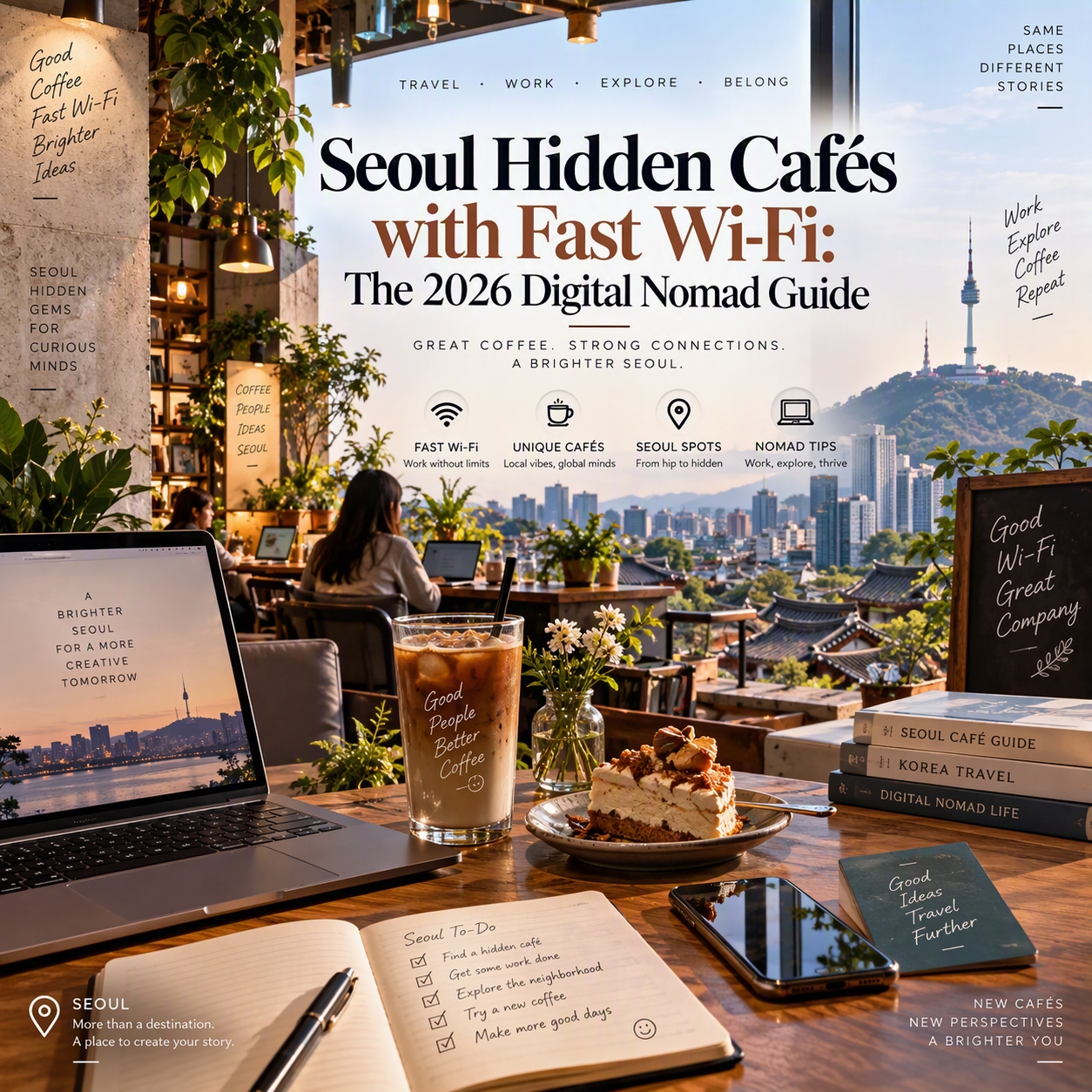
Looking for a comfortable place to work, study, or get online while visiting Seoul? Discover laptop-friendly cafés, public Wi-Fi options, practical café etiquette, and some of the city’s most interesting work-friendly spaces in 2026.
You have just arrived in Seoul after a long flight from Incheon International Airport.
Your luggage is at the hotel, your phone is connected, and now you need somewhere to open your laptop.
Maybe you need to answer emails.
Maybe you have an online class.
Perhaps you need to join a video meeting, edit photographs, plan your next day in Korea, or simply sit somewhere comfortable with a coffee while you catch up on work.
Then you look around.
There seems to be a café everywhere you go.
That is one of the great things about Seoul. Coffee shops are deeply integrated into everyday life, and many offer comfortable seating, drinks, desserts, and internet access.
But there is an important difference between finding a café with Wi-Fi and finding a café that is genuinely comfortable for working.
Not every café is designed for long laptop sessions. Some are better for a quick coffee, some are busy social spaces, and others are particularly suitable for studying or working.
This guide will help you choose more wisely.
Key Takeaways
- South Korea had 106,452 coffee-specialty establishments in 2023, according to the Ministry of Agriculture, Food and Rural Affairs.
- The number of cafés subsequently showed signs of contraction: National Tax Service data reported by Yonhap counted 95,337 cafés in operation in the first quarter of 2025.
- Café policies vary, so do not assume that every café allows unlimited laptop use or long stays.
- Look for comfortable seating, accessible power outlets, reliable internet, and enough space for your work.
- Haru&Oneday in Seongsu is specifically described by VisitKorea as a good café for laptop work and studying, with tables equipped with power outlets.
- Anthracite Yeonhui has a spacious second floor with a long communal table and plenty of seating, and Visit Seoul specifically describes it as suitable for working.
- Anthracite Hapjeong is a good choice if you enjoy Seoul’s industrial-style cafés and converted buildings.
- Cafe Onion Seongsu is another famous example of a former industrial building transformed into a café.
- Seoul operates a large public Wi-Fi network and is upgrading its infrastructure in 2026.
- Wi-Fi speed can vary by café, time of day, network congestion, and device, so it is better not to treat any café as permanently having the “fastest Wi-Fi” unless a current speed test confirms it.
- Always check the café’s current rules and conditions before settling in for a long work session.
Why Seoul Is Such an Interesting City for Café Work
Seoul has developed one of the world’s most distinctive café cultures.
You can find tiny neighborhood coffee shops, large multi-floor cafés, bakeries, modern designer spaces, converted factories, traditional buildings, and cafés inside former industrial properties.
The scale of South Korea’s coffee industry is remarkable.
According to the Ministry of Agriculture, Food and Rural Affairs, South Korea had 106,452 coffee-specialty establishments in 2023, up 5.7% from the previous year. Coffee-specialty establishments accounted for 13.4% of all foodservice establishments in 2023.
However, the industry has also been experiencing changes.
National Tax Service data reported by Yonhap showed 95,337 cafés in operation in the first quarter of 2025, 743 fewer than a year earlier. Yonhap reported that this was the first year-on-year decline since the current record series began in 2018.
So rather than saying that cafés simply keep increasing every year, it is more accurate to say that South Korea has an exceptionally large café industry that is also experiencing competition and change.
For travelers, the practical result is simple:
You will have an enormous number of cafés to choose from in Seoul.
The challenge is finding one that matches what you actually need.
What Makes a Good Laptop-Friendly Café?
A café can serve excellent coffee and still be a poor place to work.
Before opening your laptop, consider several practical factors.
| What to check | Why it matters |
|---|---|
| Wi-Fi | Essential for online work and communication |
| Power outlets | Important for longer laptop sessions |
| Seating | Some tables are much more comfortable for laptops than others |
| Noise | Busy cafés may not be suitable for meetings |
| Table size | More space makes working easier |
| Café policy | Individual businesses may have restrictions |
| Opening hours | Always check current hours before visiting |
| Location | A nearby café can save time during a busy sightseeing day |
If you are working for only 30 minutes, almost any comfortable café may be sufficient.
If you need to work for several hours, however, the seating and atmosphere become just as important as the coffee.
1. Haru&Oneday – A Strong Choice for Laptop Work
If your priority is finding a café where you can actually work on a laptop, Haru&Oneday in Seongsu is one of the most useful options to know.
VisitKorea specifically describes the café as a place that has become known for working or studying on a laptop because it has tables with plugged-in outlets.
The café has a quiet and cozy atmosphere with a modern interior. It is also associated with SUPER JUNIOR’s Donghae, and photographs taken by him are displayed inside.
Why consider Haru&Oneday?
- Tables with power outlets
- Suitable for laptop work and studying
- Quiet and comfortable atmosphere
- Located in Seongsu
- Coffee, milk tea, desserts, and drinks
Address: 92 Achasan-ro, Seongdong-gu, Seoul
VisitKorea currently lists the café as open from 08:00 to 22:30 Monday to Friday and 09:00 to 22:30 on weekends.
Opening hours can change, so check the current information before visiting.
If productivity is more important to you than simply finding a photogenic café, this is one of the places worth considering.
2. Anthracite Yeonhui – Spacious and Comfortable
Another interesting choice is Anthracite Yeonhui in Yeonhui-dong.
Visit Seoul describes its second floor as spacious, with a long communal table and plenty of seating, and specifically says that the space provides an ideal setting for working.
The interior is also part of the attraction.
The design creates a strong contrast between darker areas and a bright space with a large floor-to-ceiling window.
Why consider Anthracite Yeonhui?
- Spacious second floor
- Long communal table
- Plenty of seating
- Work-friendly environment
- Distinctive interior
- Coffee, desserts, wine, and herbal teas
Visit Seoul currently lists the café’s hours as 08:50–22:00 daily, with last order at 21:30.
If you want somewhere that feels more like a spacious café workspace than a small neighborhood coffee shop, this is a particularly interesting option.
3. Anthracite Hapjeong – Coffee in a Former Shoe Factory
For travelers who enjoy Seoul’s industrial architecture, Anthracite Hapjeong is a memorable stop.
The café occupies a building that was once a shoe factory, and the original industrial character has been retained as part of the café’s design.
Visit Seoul describes the location as an example of Seoul’s industrial-chic café culture.
The building’s previous identity has not simply been erased.
Instead, elements of the former factory have been incorporated into the café.
Why visit?
- Former shoe-factory building
- Industrial interior
- Coffee and desserts
- Distinctive atmosphere
- Good choice for travelers interested in Seoul’s adaptive reuse of older buildings
However, remember that an attractive café is not automatically a dedicated coworking space.
If you have an important meeting or need several hours of uninterrupted work, check the seating and current café policy first.
4. Cafe Onion Seongsu – A 1970s Industrial Building
Cafe Onion Seongsu is one of the best-known examples of Seoul’s industrial buildings being given a new life.
According to Visit Seoul, the building dates from the 1970s and was previously used as an industrial factory making small parts. Before that, it had also served other purposes, including a supermarket, restaurants, and a residence.
Many elements of the building’s industrial past remain visible today.
The café is also known for its extensive bakery selection. Visit Seoul currently notes that it offers more than 20 varieties of bread.
What makes Cafe Onion interesting?
- Converted 1970s industrial building
- Distinctive architecture
- Coffee and bakery products
- Famous Seongsu location
- Strong connection to the neighborhood’s industrial history
Cafe Onion is best approached as a café and bakery experience, rather than assuming it is a dedicated remote-work venue.
If you need a quiet environment for an important business meeting, another café or your accommodation may be a better option.
Seoul’s Café Culture Has a Long History
Coffee culture in Korea did not suddenly appear with modern café chains.
The history is considerably more complicated.
The National Folk Museum of Korea explains that one of the earliest known written references to coffee in Korea dates to 1860, decades before the commonly cited story of King Gojong drinking coffee in 1896.
The museum documents coffee references during the late Joseon period, including records concerning coffee imports and consumption.
Coffee gradually became more widely available, and cafés and coffee-serving establishments developed alongside Korea’s modernization.
This history helps explain why cafés are now such an important part of everyday life in Korea.
Seongsu: One of Seoul’s Best Areas for Café Hopping
If you only have limited time in Seoul and want to explore modern café culture, Seongsu is an excellent area to consider.
The neighborhood is particularly famous for its transformation from an industrial district into a fashionable destination filled with cafés, restaurants, galleries, shops, and creative businesses.
It is also a great place to see how Seoul reuses older buildings.
Cafe Onion, for example, occupies a former industrial building dating from the 1970s.
Haru&Oneday provides a very different experience, with a quieter atmosphere and tables with outlets that are specifically noted as suitable for laptop work.
You can combine café hopping with:
- Seoul Forest
- Independent shops
- Bakeries
- Restaurants
- Galleries
- Fashion stores
- Photography
That makes Seongsu particularly useful for travelers who want to combine work with sightseeing.
Hapjeong and Mapo
Hapjeong and the surrounding Mapo area offer another side of Seoul’s café culture.
You will find independent cafés alongside restaurants, shops, residential streets, and cultural attractions.
Anthracite Hapjeong is one of the best-known examples of the area’s industrial-style cafés.
The former shoe factory building provides a very different atmosphere from the modern glass-and-steel cafés found elsewhere in Seoul.
If you enjoy exploring neighborhoods rather than visiting only famous tourist attractions, Mapo is a good area to add to your itinerary.
Yeonhui-dong
Yeonhui-dong is another area worth considering if you want a somewhat more relaxed café experience.
Anthracite Yeonhui is particularly notable because Visit Seoul specifically describes its spacious second floor and communal table as suitable for working.
You can also combine the neighborhood with other parts of western Seoul during the same day.
Seoul Public Wi-Fi in 2026
Café Wi-Fi is not your only connectivity option.
Seoul operates a large public Wi-Fi network covering places such as major streets, traditional markets, parks and riverside areas, bus stops, tourist attractions, cultural facilities, welfare facilities, and city and village buses.
The city is also upgrading its public Wi-Fi infrastructure in 2026.
The Seoul Metropolitan Government announced a plan to replace 2,020 aging public Wi-Fi units and introduce Wi-Fi 7 as part of a wider effort to improve speed and stability.
The 2026 plan also includes expanding “data-free zones” in major tourist areas including Myeongdong, Seongsu, and Hangang areas.
Seoul currently provides a secure public Wi-Fi option called SEOUL_Secure.
According to the city’s official instructions, users can select SEOUL_Secure or SEOUL_Secure_(3) and use the published ID and password to connect. The city identifies SEOUL_Secure_(3) as using WPA3-Enterprise.
This makes Seoul’s public Wi-Fi useful as a backup when you are moving around the city.
Should You Rely Only on Public Wi-Fi?
No.
Even though Seoul’s public Wi-Fi infrastructure is extensive, travelers should still have a backup connection.
A practical setup is:
- Use café Wi-Fi when available.
- Keep mobile data available as a backup.
- Download important documents before leaving your accommodation.
- Save essential travel information for offline use.
- Avoid handling highly sensitive information on unfamiliar networks whenever possible.
Seoul itself recommends caution when using public Wi-Fi and advises users to minimize sensitive personal information and financial transactions on public networks.
For travelers who need continuous internet access, a Korean SIM/eSIM or another reliable mobile-data option can be useful.
Do Seoul Cafés Have a Two-Hour Laptop Limit?
There is no universal two-hour rule for Seoul cafés.
This is an important distinction.
Individual cafés can have their own policies regarding laptop use, seating, or how long customers can remain at a table. Those policies may also change depending on the business and how busy it is.
Therefore, do not assume that every café gives you unlimited use after buying one drink.
Instead:
- Look for posted rules.
- Ask staff if you are unsure.
- Avoid occupying a large table unnecessarily.
- Consider moving when the café becomes crowded.
- Respect any laptop or seating restrictions.
The right café for a three-hour work session is not necessarily the right café for a quick coffee.
Seoul Café Etiquette for Laptop Users
Working from a café is easy when you respect the business and the people around you.
1. Check the atmosphere first
Before opening your laptop, look around.
If every table is occupied and customers are waiting, a long work session may not be appropriate.
2. Order something
If you plan to stay and work, purchase something rather than treating the café as a free office.
3. Choose an appropriate table
If you are alone, avoid taking a large table intended for several people when smaller seating is available.
4. Keep your voice down
This is especially important during video calls.
Use headphones and speak quietly.
5. Check for an outlet before settling in
If you need to work for several hours, make sure your chosen seat actually has access to power.
6. Follow the café’s rules
If there is a sign about laptop use, seating time, or particular tables, follow it.
7. Don’t leave valuable belongings unattended
If you need to leave the café, take your laptop, passport, wallet, and other valuables with you.
Can You Take Video Calls in a Seoul Café?
Yes, but choose your location carefully.
A café may have good internet and still be a terrible place for a video meeting because of background noise.
For an important meeting:
- Use headphones.
- Choose a quieter café.
- Avoid the busiest periods.
- Speak quietly.
- Sit away from entrances and counters.
- Keep mobile data available as a backup.
- Consider using your accommodation for confidential meetings.
For casual calls, cafés can work very well.
For an important business presentation, however, a private environment is usually the better option.
How to Find More Laptop-Friendly Cafés
You do not need to rely on a single list of cafés.
Before visiting a café, check its most recent information on a Korean map service or the café’s own official social-media page.
Look for:
- Recent customer photos
- Current opening hours
- Seating arrangements
- Power outlets
- Recent comments about laptop use
- Any posted restrictions
This is particularly important because cafés can change their furniture, opening hours, menus, and policies.
An old blog post may describe a café very differently from what you find when you arrive.
A Simple Café-Work Strategy for Seoul
If you need to work during your trip, you do not necessarily need to spend the entire day in one café.
Morning
Choose a café with comfortable seating and power access.
Start your most demanding work while you have plenty of energy.
Afternoon
Take a break and explore the neighborhood.
Move to another café if you still need to work.
Evening
If you need a quiet environment for an important task, consider returning to your accommodation rather than trying to work in an increasingly busy café.
This approach allows you to experience Seoul instead of spending an entire day behind a laptop.
Best Seoul Cafés for Different Needs
| Café | Area | Best for | What stands out |
|---|---|---|---|
| Haru&Oneday | Seongsu | Laptop work and studying | VisitKorea notes tables with plugged-in outlets |
| Anthracite Yeonhui | Yeonhui-dong | Spacious work sessions | Large second floor and communal table |
| Anthracite Hapjeong | Hapjeong | Industrial café experience | Former shoe-factory building |
| Cafe Onion Seongsu | Seongsu | Coffee and bakery experience | Converted 1970s industrial building |
This is not a ranking of the cafés by internet speed.
Actual Wi-Fi performance can vary depending on the network, location, number of connected users, device, and time of day.
Unless a café publishes a current measured speed, it is better not to advertise an exact Mbps figure as a permanent fact.
Frequently Asked Questions
Do Seoul cafés have Wi-Fi?
Many Seoul cafés provide Wi-Fi, but access arrangements vary between businesses. If you cannot find the network information, ask the staff.
Can I work on my laptop in a Seoul café?
Often, yes. However, individual businesses can have their own rules. Look for cafés with appropriate seating and check any posted restrictions.
Which Seoul café is specifically known for laptop work?
Haru&Oneday in Seongsu is specifically described by VisitKorea as a good café for working or studying on a laptop, with tables that have plugged-in outlets.
Are there cafés with spacious work-friendly seating?
Yes. Visit Seoul specifically describes the second floor of Anthracite Yeonhui as spacious, with a long communal table and plenty of seating suitable for working.
Is there a two-hour rule in Seoul cafés?
No universal two-hour rule applies to all Seoul cafés. Individual businesses can establish their own policies.
Is Seoul public Wi-Fi free?
Seoul operates free public Wi-Fi in many public locations, including major streets, parks and riverside areas, traditional markets, bus stops, tourist attractions, cultural facilities, and public transportation.
Should I use public Wi-Fi for sensitive work?
It is better to use a trusted connection for sensitive information. Seoul itself advises caution when using public Wi-Fi and recommends minimizing sensitive personal information and financial transactions.
Which neighborhood is best for café hopping?
Seongsu is one of the strongest choices because of its combination of cafés, converted industrial buildings, restaurants, shops, and cultural attractions.
Final Thoughts: Finding Your Perfect Seoul Work Café
Seoul’s café culture is about much more than finding the café with the fastest internet.
The city gives you the opportunity to work surrounded by converted factories, modern interiors, neighborhood cafés, bakeries, and creative districts.
If productivity is your priority, start with a café that is specifically known to accommodate laptop users, such as Haru&Oneday.
If you want spacious seating and a work-friendly environment, Anthracite Yeonhui is worth considering.
If atmosphere and architecture are more important, explore Anthracite Hapjeong or Cafe Onion Seongsu and experience Seoul’s remarkable transformation of older industrial buildings.
And if you are staying in Seoul for several days, do not limit yourself to one location.
Work for a while.
Take a walk.
Explore a new neighborhood.
Try another café.
Then get back to work.
That combination of productivity, exploration, coffee, and city life is part of what makes Seoul such an interesting destination for travelers who need to stay connected.
Your laptop does not have to keep you inside your hotel room. Seoul can be your temporary office too—just remember that every café is a business first, so respect the space, follow the rules, and enjoy the experience.
Leave a Reply