
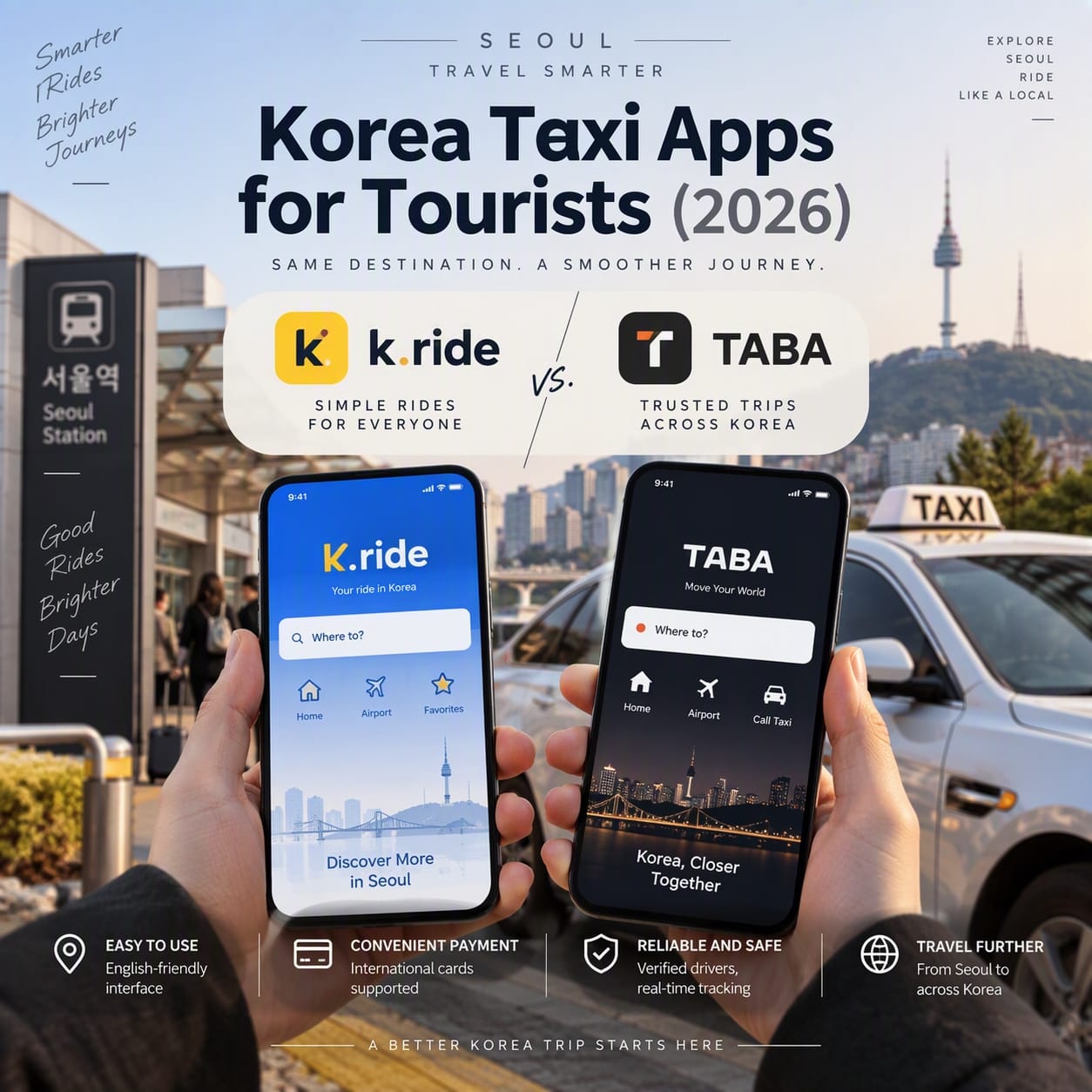
Getting a taxi in Korea is straightforward once you know which app accepts your sign-up details, how the meter works, and where you should meet your driver. For visitors without a Korean mobile account, k.ride and TABA are two options built for international travelers. Neither is guaranteed to be the cheapest or quickest on every trip: the useful choice depends on your location, available taxis, vehicle type, payment screen, and live estimate.
The practical approach is to install your preferred app before travel, add a supported payment method if the app allows it, and compare the actual quote at the time you need a ride. Keep a backup such as a taxi stand, a street taxi, or public transit for busy periods.
k.ride: a global-facing app from Kakao Mobility
k.ride is Kakao Mobility’s service for international users. Its official page lists English, Japanese, and Simplified and Traditional Chinese interfaces, destination search in many languages, translated in-app driver chat, fare estimates, and credit/debit card or mobile payment. Kakao Mobility’s launch notice says travelers can register using an international phone number and sign in through email or Google/Apple, and can add a foreign-issued card.
After entering a pickup point and destination, review the vehicle category, estimate, and payment method displayed in your version of the app. The available classes can include standard, larger, deluxe, or luxury rides, but the options depend on place and time. The app may be especially useful when you want to share a pickup pin or send a message without speaking Korean. Do not assume it will always find a car instantly; matching depends on local supply, weather, traffic, and demand.
TABA: a traveler-oriented taxi app
TABA is promoted as a service for visitors and was introduced with support from the Seoul Metropolitan Government. Its official site says users can sign up with an existing mobile number, search addresses in different languages, choose from available taxi types, and pay using major international cards and other listed methods. Its current app or FAQ should be checked for the service area, vehicle options, payment support, and whether advance reservations are available for your particular trip.
TABA may be convenient when it covers your pickup and destination, but do not rely on old descriptions of its coverage or promotions. Open the app and see what it offers at your current location. A limited choice of available vehicles is not proof of a lower fare; compare the actual fare display and conditions with your other option.
Which one should you open?
| Need | What to check |
|---|---|
| Foreign-number sign-up | k.ride and TABA both describe international-user sign-up; verify your number during setup. |
| English help | Check each app’s current language list and support details. |
| Fare estimate | Compare the amount, vehicle class, and any fee shown before you confirm. |
| Pickup outside central Seoul | Check whether the app currently serves both ends of the trip. |
| Driver communication | Use the in-app pickup pin and translated chat where available; avoid sharing unnecessary personal details. |
A sensible setup is to have one app ready and the other installed as a backup. You do not need both if one works reliably for your itinerary. Never select a premium or larger vehicle unless the displayed fare and vehicle type are acceptable to you.
How Seoul taxi fares work
Seoul’s official fare page lists the standard daytime sedan meter starting at ₩4,800 for up to 1.6 km, with distance and time charges after that. It also lists late-night surcharges: the starting fare and meter rates are higher from 10 p.m. through 4 a.m., with the largest surcharge between 11 p.m. and 2 a.m. The official table is the best place to check current tariff details because fares can change (Seoul taxi fare table).
That starting fare is not the price of every ride. Traffic, distance, waiting time, late-night periods, travel outside Seoul, toll roads, and the vehicle category can change the final total. App estimates are estimates; check the meter and any in-app conditions. For an airport trip, compare an app quote with the official taxi stand or fixed-fare information posted at the airport. Avoid accepting unsolicited offers from people approaching you inside the terminal.
Set up before your first ride
- Install from your phone’s official app store. Make sure you select the global/traveler app with the correct publisher.
- Verify your own number while you can receive SMS. Registration steps can change, so finish setup before your first late-night ride.
- Add a payment method only through the official app. Check accepted card networks and your bank’s authentication prompt. Keep a physical card available as a backup.
- Save your hotel’s name and address in Korean. Confirm the pin matches the entrance, not a nearby road or the opposite side of a large avenue.
- Review the ride before tapping request. Confirm the pickup pin, destination, vehicle, fare estimate, and payment mode.
Meeting the driver and riding safely
Follow the pickup pin and the app’s instructions. At large stations, malls, hospitals, and airports, a driver may not be able to stop at your exact location; move to the designated taxi pickup area if instructed. Match the vehicle and plate details in the app before getting in. If the car or driver does not match, do not board; cancel through the app or contact support.
When the ride is underway, the driver’s navigation should have your destination if it was entered correctly. If you need to clarify a hotel entrance, use the in-app translated chat when available or show the address in Korean. Keep your belongings with you, wear the seat belt, and use a taxi stand or another service if you feel unsafe. Save or screenshot the ride receipt for your records.
For a metered ride, the meter should run. An app-dispatched ride may use in-app automatic payment, while a street taxi may take a card or cash depending on the vehicle. Follow the payment method shown for that specific booking; do not pay twice. If you believe a fare or route was improper, keep the receipt and booking details and use the app’s support channel or Seoul’s official taxi complaint guidance.
Common mistakes to avoid
- Assuming a fixed fare from the base fare: the meter continues charging by distance and time.
- Standing at the wrong pickup point: a pin across a divided road can add a long detour; check the map carefully.
- Taking an unsolicited airport ride: use marked taxi ranks or a verified app booking.
- Paying twice: check whether the app will charge automatically before handing over cash or a card.
- Expecting every driver to accept every destination: availability can vary. If no match appears, try another legal pickup point or transport option.
- Confusing vehicle upgrades with ordinary service: check the selected category and price before confirming.
Frequently asked questions
Do tourists need an ARC to use k.ride or TABA?
The services are designed to support international users and describe registration with foreign numbers. Their requirements can change, so check the app’s current setup flow and accepted payment methods.
Is ₩4,800 the price of a Seoul taxi ride?
No. It is the standard daytime starting fare for the initial distance listed by Seoul. Distance, time, night surcharges, tolls, and vehicle type can raise the total.
Can I use either app everywhere in Korea?
Coverage and available taxi categories vary. Check the app map and service details for your pickup and destination before relying on it.
Should I tip a taxi driver?
Tipping is not generally expected for ordinary taxi rides. Pay the fare shown by the meter or booking and any applicable charges.
Bottom line
k.ride and TABA make taxi booking more accessible for many visitors, but the best choice is the one that accepts your setup and shows a suitable ride for your actual location. Prepare the apps before you need them, check the price and vehicle on screen, use a verified pickup point, and keep a backup plan for busy periods.
How to compare the price shown in an app
A taxi’s base fare is only the starting amount, not the total cost of a typical trip. Seoul’s official fare page lists the standard sedan daytime base fare as ₩4,800 for the first 1.6 km, then distance and time charges. The meter can account for time as well as distance, and late-night and out-of-area surcharges may apply. Rates differ by vehicle class and can change, so check the current Seoul Metropolitan Government fare table before travel (Seoul taxi fares and usage guide).
Before confirming a ride, read what the app’s estimate includes and which service class you selected. An estimate may change with traffic or route conditions; a premium or larger vehicle is not priced like an ordinary sedan. If a trip uses a toll road, the official city guidance says the actual toll may be collected when the passenger requests that route. Check your receipt against the app’s fare breakdown instead of assuming that the base fare is the final bill.
k.ride and TABA: choose by the live trip details
k.ride is Kakao Mobility’s international-facing service. TABA’s own materials describe its service as a way for international visitors to call taxis without the normal Korean account flow. App features, supported payment methods, availability, vehicle types, and promotions can change. Do not rely on old claims that one app always has more drivers, never charges a fee, or guarantees a particular wait. At the pickup point, compare the live fare estimate, vehicle option, expected arrival, and cancellation terms shown in each app.
Where service is available, enter the destination in the app and use a clear pickup point. A large building entrance, hotel lobby, or correctly identified curb can be easier than a pin in the middle of a multi-lane road. Check the car model and registration number against the booking before getting in. If the plate, vehicle, or driver shown in the app does not match, do not board; use the app’s help function or choose another ride.
Airport trips, tolls, and the taxi meter
At Incheon Airport, follow the app’s designated pickup instructions for your terminal rather than standing in the regular taxi queue and expecting the booked driver to find you. Airport access and waiting rules differ by pickup area. If you are carrying luggage or travelling with several people, select a vehicle that can safely fit both passengers and bags; a standard sedan may not have space for large suitcases.
For a metered taxi, the meter—not an old blog’s quoted flat fare—is the starting reference for an ordinary street ride. Seoul lists specific approved flat or zone fares for some airport services and other special services, so use those only when the service is clearly identified and its terms are shown. Keep the app receipt. Seoul has also introduced a QR-based complaint channel for foreign passengers to report fare or service problems. If the amount appears wrong, save the receipt and ride details and use the official reporting route rather than arguing in traffic.
When app booking is not the best option
At a busy curb, a taxi stand or a clearly marked airport taxi rank may be simpler than waiting for an app match. In dense central districts, walking a short distance to a legal pickup point can help the driver reach you safely. During a storm or a major event, supply and travel time may be poor for every service; compare the app’s updated arrival estimate with the subway or bus. Avoid boarding a vehicle that solicits you without a clear meter or confirmed booking, especially at transport hubs.
If you are unsure about a destination, show the driver the Korean address in the app or a map pin. Do not depend on spoken English or a translated street name alone. In the car, fasten your seat belt, keep valuables with you, and check that you have your belongings before leaving. If a dispute arises, note the taxi number, time, route, and receipt, then contact the app or the city’s official taxi complaint service.
Simple decision guide
- Use k.ride if its supported sign-in, payment options, vehicle choice, and arrival estimate suit the trip you are booking.
- Compare TABA when it is available at your location; check the current estimate and terms instead of assuming it is always free or faster.
- Use an official taxi stand when you are at a station or airport and would rather take the next available licensed taxi.
- Use transit when a taxi queue is long, the fare estimate is high, or traffic makes a car trip impractical.
The key is to treat taxi apps as useful booking and communication tools, not as a promise of a fixed fare or instant car. Verify the ride, check the current fare details, and keep a backup plan for late-night or high-demand periods.
Leave a Reply